
railway-international.com
22
'26
Written on Modified on
Stadler and ARST Unveil World’s First Narrow-Gauge Hydrogen Train
Compared to the use of diesel trains, the ten hydrogen trains ordered by ARST will save over 2,100 tonnes of CO₂ per year, equivalent to around 450 trips around the globe by car.
stadlerrail.com
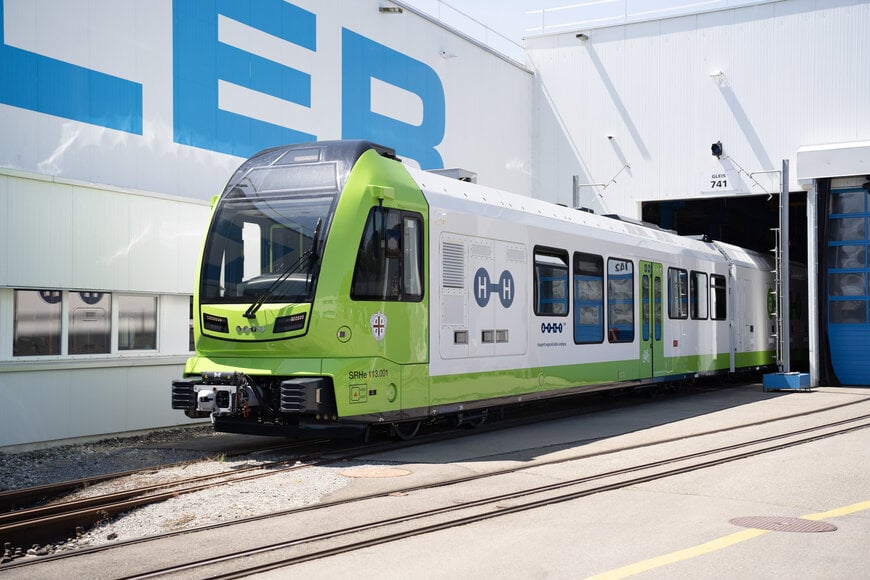
Stadler and the Sardinian transport company Trasporti Regionali della Sardegna (ARST) have unveiled the world’s first hydrogen-powered train designed specifically for narrow-gauge lines at the commissioning centre in Erlen, Switzerland. The new trains are scheduled to enter passenger service from 2028 on the narrow-gauge networks operated by ARST, establishing passenger connections along the Alghero Airport – Mamuntanas, Sassari – Alghero, and Sassari – Sorso routes.
Fuel Cell Propulsion and Renewable Infrastructure
The deployment of the hydrogen fleet is engineered to transition regional rail infrastructure away from fossil-fuel reliance. Under the ten-train order placed by ARST, the deployment of the hydrogen-powered units will save over 2,100 tonnes of CO₂ emissions per year compared to traditional diesel-powered rolling stock.
The propulsion architecture is built around an integrated hydrogen fuel cell and storage tank assembly. This entire power-generation hardware is housed inside a dedicated central carriage module designated as the "Power Pack." The system functions as a mobile battery charger, continuously converting stored hydrogen gas into electrical energy to power the primary traction motors and replenish the onboard traction battery banks. This setup allows the vehicles to navigate non-electrified regional tracks without requiring overhead catenary infrastructure. To achieve a completely zero-emission supply chain, the fueling infrastructure relies on hydrogen produced via production plants powered 100 percent by solar energy arrays.
Narrow-Gauge Structural Design and Fleet Testing
Italian narrow-gauge infrastructure constraints impose low maximum axle load limits on operating rolling stock. In response to these track conditions, the vehicle platform features a specialized narrow profile constructed from advanced lightweight materials to satisfy track structural limits across regional networks.
The vehicle interior incorporates low-floor access points to streamline boarding protocols for passengers with reduced mobility, paired with panoramic windows, automated climate control, and minimized structural vibration baselines compared to diesel trains. The operator cabin provides the crew with a dedicated private access door and an independent air-conditioning system. Prior to active revenue service deployment, the fleet will undergo formal field validation and structural testing to satisfy safety guidelines mandated by Italy’s National Agency for the Safety of Railways and Road and Motorway Infrastructure (ANSFISA).
Multi-Regional Italian Procurement Framework
The delivery stems from a formal Framework Agreement signed between ARST and Stadler in 2023 covering a total supply of ten vehicles for the Sardinian regional network. The modernization program is backed by an initiative from the Italian government and the Ministry of Infrastructure and Transport targeting the systematic decarbonisation of national rail corridors.
The hydrogen technology developed by Stadler is also being adopted by adjacent regional transport operators in Italy. The production backlog at Stadler’s manufacturing headquarters in Bussnang, Switzerland, includes the fabrication of nine narrow-gauge hydrogen units for Ferrovie della Calabria (FdC) and two units destined for the Ferrovia Circumetnea (FCE) network in Sicily.
Edited by Romila DSilva, Induportals Editor, with AI assistance.
www.stadlerrail.com
