
railway-international.com
31
'26
Written on Modified on
Stadler to Supply 45 Hybrid Locomotives to VIA Rail
The contract includes a 20-year support agreement and supports the decarbonization of passenger rail services across Canada.
stadlerrail.com
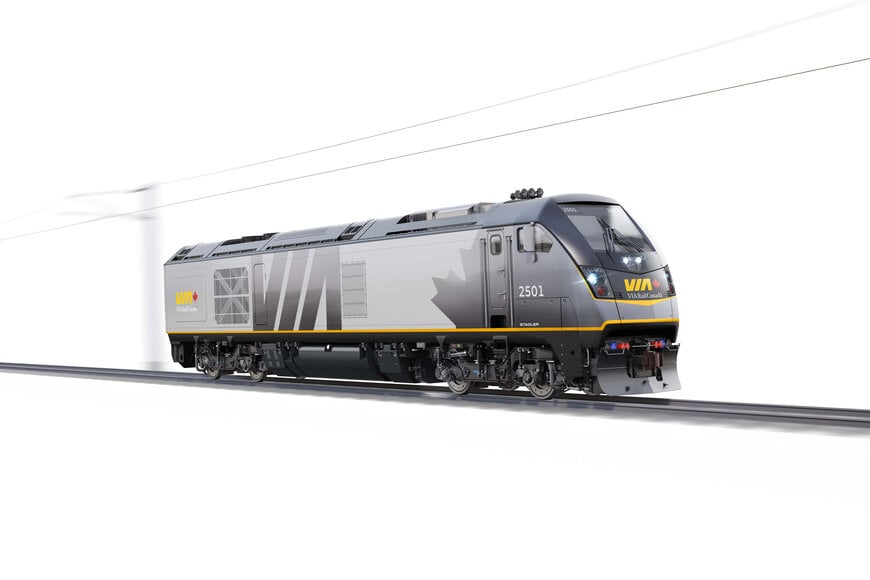
Stadler has signed a landmark contract with VIA Rail Canada to supply 45 hybrid locomotives, marking the manufacturer's first locomotive order in the country. Designed to operate reliably in demanding climates with temperatures dropping to -50°C, the fleet combines proven diesel-electric technology with an innovative battery-assisted traction system. The order supports VIA Rail’s Long-Distance, Regional and Remote Rail (LDRR) program and includes a comprehensive 20-year Technical Support and Spare Supply Agreement (TSSSA) to ensure long-term availability and cost-effective operation.
Hybrid Technology and Performance
The new locomotives are equipped with traction battery modules that supply energy for onboard auxiliary systems, head-end power, and traction. By combining battery power with the diesel engine, the vehicles deliver up to 4 MW of power at the wheel, a starting tractive effort of 350 kN, and a maximum operating speed of 160 km/h (100 mph). The hybrid architecture captures and stores braking energy, significantly improving energy efficiency while lowering greenhouse gas emissions. In environmentally sensitive areas or at stations, the trains can operate in battery-only mode to eliminate local exhaust and reduce noise. Additionally, the battery system provides operational resilience, allowing the locomotive to reach a safe location in the event of a powertrain failure.
Sustainable Design and Localization
Engineered for Canada's vast geography, the fleet utilizes technologies proven in harsh winter environments like Sweden and Norway. The locomotives are designed with a focus on sustainability, featuring recyclability rates above 92%, recoverability rates exceeding 95%, and battery systems optimized for second-life applications. Stadler Valencia in Spain will manage the design and manufacturing, while a portion of the assembly, testing, and commissioning will take place in Canada. The 20-year TSSSA will be executed by a newly incorporated Canadian subsidiary, creating skilled manufacturing and maintenance jobs at VIA Rail facilities in Montreal, Toronto, Winnipeg, and Vancouver.
Additional Context
This section details technical frameworks and market dynamics not included in the original corporate announcement.
The integration of battery-diesel hybrid propulsion in heavy passenger rail represents a critical transitional technology for North American operators aiming to meet net-zero targets on vast, non-electrified routes. By utilizing regenerative braking on long descents—a common operational scenario in Canada's diverse topography—operators can significantly reduce mechanical brake wear alongside diesel consumption. Stadler’s entry into the Canadian heavy rail market places it in direct competition with established North American rail manufacturers such as Siemens Mobility and Alstom. Furthermore, the inclusion of a 20-year TSSSA highlights a growing industry trend where transit agencies shift long-term lifecycle maintenance risks and supply chain management directly to the Original Equipment Manufacturer (OEM).
Edited by Lekshman Ramdas, Induportals editor – adapted by AI.
www.stadlerrail.com
