
railway-international.com
29
'26
Written on Modified on
Siemens Mobility Signs Major Locomotive Agreement at InnoTrans 2026
European rail vehicle leasing company RAILPOOL expands traction capacity across electrified and non-electrified routes with software-defined digital fleet integration.
www.siemens.com
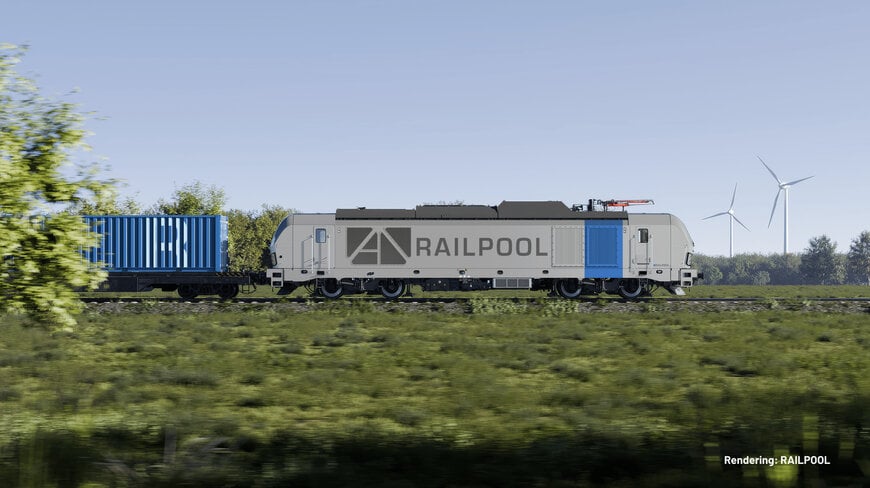
Siemens Mobility and RAILPOOL have signed an order for the supply of 100 locomotives to modernize freight and passenger operations across European rail corridors. The agreement includes a firm initial call-off of 30 alternating-current units and 50 dual-mode units, alongside an option for 20 additional units, establishing digital fleet integration across mixed-power networks.
Software Architecture and Connected Cockpit Integration
The software-defined locomotive platform integrates an open digital platform directly into the driver cab, converting the operating console into a connected terminal via a dedicated Smart Screen interface. Applications delivered through an onboard software repository include Remote Start, automated traction optimization via Vectron Eco Cruise, and interactive driver evaluation functions. Standardized application programming interfaces allow external fleet management services, remote condition monitoring, and telemetry platforms to interface directly with vehicle hardware. RAILPOOL implements the Core digital base package alongside standardized data interfaces to align locomotive telematics directly with existing maintenance planning systems.
Mechanical Specifications and Traction Parameters
Dual-mode units utilize a standard 1,435 mm track gauge with a service weight of 90 metric tons. Traction systems support overhead line operation under 15 kV alternating current, with optional configurations accommodating 25 kV AC lines. Maximum wheel-rim power delivery reaches 2,400 kW during catenary-fed electric operation and 2,000 kW under diesel power generation. The onboard fuel reservoir stores 2,600 liters of diesel fuel, supporting non-electrified mainline and terminal runs at operating speeds up to 160 km/h. Passenger-configured variants across the platform architecture support maximum homologated operating speeds of up to 230 km/h across 20 European jurisdictions.
Manufacturing and Delivery Schedule
Manufacturing of the ordered units will take place at the Siemens Mobility production facility in Munich-Allach. Deliveries under the framework contract commence in 2027, expanding RAILPOOL's operational fleet from 209 operational platform units toward a total deployment of 325 units. The contract signing occurred during InnoTrans 2026 in Berlin, Germany.
Additional Context:
This section details technical specifications and competitive benchmarking not included in the original product announcement
Within the European electro-diesel locomotive sector, the primary benchmark against the four-axle (Bo'Bo') 90-ton platform is the six-axle (Co'Co') Stadler Eurodual. The platform delivered by Siemens Mobility operates at a total service weight of 90 metric tons, producing an axle load of 22.5 metric tons, compared to the Stadler Eurodual's total operating weight of 114 to 126 metric tons with an axle load of 19 to 21 metric tons across six axles.
In terms of power performance, the Siemens dual-mode unit provides 2,400 kW at the wheel under catenary power and 2,000 kW under diesel traction, achieving starting tractive effort optimized for four-axle configurations. In contrast, the Stadler Eurodual offers up to 6,150 kW under 15 kV or 25 kV AC catenary and up to 3,000 kW via its diesel prime mover, generating a starting tractive effort of 500 kN suited for heavy freight haulage. For operational speed, the four-axle platform reaches 160 km/h under dual-mode operation and up to 230 km/h in pure passenger configurations, while the standard Eurodual freight configuration operates at top speeds between 120 km/h and 160 km/h.
Edited by Natania Lyngdoh, Induportals editor, assisted by AI.
www.siemens.com
