
railway-international.com
16
'26
Written on Modified on
Battery-Electric Multiple Units for Regional Rail Electrification
Siemens Mobility deploys 113 Mireo Plus B trains and Railigent X maintenance for LNVG and RGB to eliminate diesel on uncatenaried tracks.
www.siemens.com
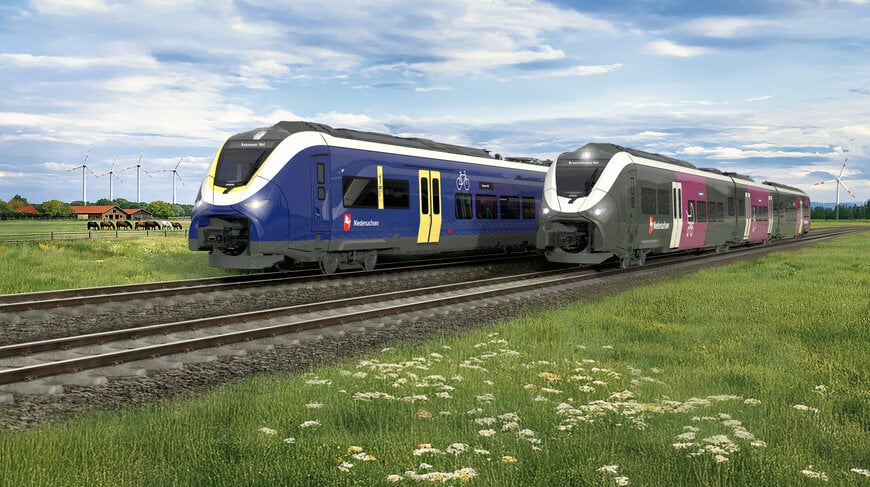
Siemens Mobility, Landesnahverkehrsgesellschaft Niedersachsen (LNVG), and Regionalverband Großraum Braunschweig (RGB) are deploying 113 three-car Mireo Plus B battery-electric multiple units and two maintenance depots in Lower Saxony. The cooperation addresses regional rail transport on partially electrified networks by combining dual-mode traction hardware with a 30-year digital lifecycle maintenance program.
Regional Rail Applications and Operational Challenges
The primary application area is regional passenger rail transport across Lower Saxony and the Greater Braunschweig region, where track networks lack continuous overhead contact lines. Operating emission-free rolling stock on these routes requires bridging non-electrified track sections without constructing continuous catenary infrastructure. Under the contract exceeding two billion euros, LNVG receives 83 vehicles and RGB receives 30 vehicles, with options for 132 additional units. The concrete technical use case involves dynamic battery charging under existing overhead wires and autonomous battery traction on uncatenaried segments. Furthermore, rural and regional platforms present varied heights, which the rolling stock addresses through multi-level entry doors to enable level boarding and shorten station dwell times.
Technical Solution and Partner Responsibilities
The technical solution integrates the three-car Mireo Plus B platform, valued at approximately 1.1 billion euros, with the Railigent X digital maintenance architecture. The vehicles achieve a maximum operating speed of 160 km/h and draw power via pantographs on electrified sections to drive traction motors and charge onboard traction batteries simultaneously. Each three-car configuration accommodates more than 170 seats, including six first-class seats, two wheelchair spaces, multi-purpose areas, and six to 18 bicycle storage spaces, alongside onboard Wi-Fi and passenger information systems. While LNVG and RGB manage regional transport planning and fleet allocation, Siemens Mobility is responsible for vehicle manufacturing, spare parts supply, asset management, and full lifecycle maintenance over 30 years.
Deployment and Maintenance Infrastructure
Passenger service deployment starts at the end of 2031. To integrate the fleet into existing regional rail infrastructure, the project includes constructing two Rail Service Centers in Lower Saxony, creating up to 100 technical jobs. The workshop architecture separates daily operational running maintenance at local facilities from heavy maintenance and overhauls, which are centralized in a center of competence. Siemens Mobility also executes technical training programs for operations and maintenance personnel to build local system expertise.
Expected Operational Impact
Combining dual-mode battery-electric propulsion with centralized and condition-based maintenance directly supports near-100-percent fleet availability. Using Railigent X for continuous condition monitoring allows maintenance teams to schedule interventions based on actual component wear rather than fixed intervals, reducing unplanned downtime. As Michael Peter, President of Siemens Mobility, explains: “In combination with our digital service and maintenance concept, Railigent X, we are laying the foundations for efficient and reliable fleet operation throughout the vehicles’ 30-year life cycle. At the same time, we are investing in service and maintenance capacity as well as skilled local jobs.”
Edited by Sucithra Mani, Induportals editor – adapted by AI.
www.siemens.com
