
railway-international.com
07
'26
Written on Modified on
ÖBB & Stadler Deploy Cityjet Double-Deck Regional Trains
The new rolling stock programme expands passenger capacity and accessibility across Austria’s eastern regional rail network.
stadlerrail.com
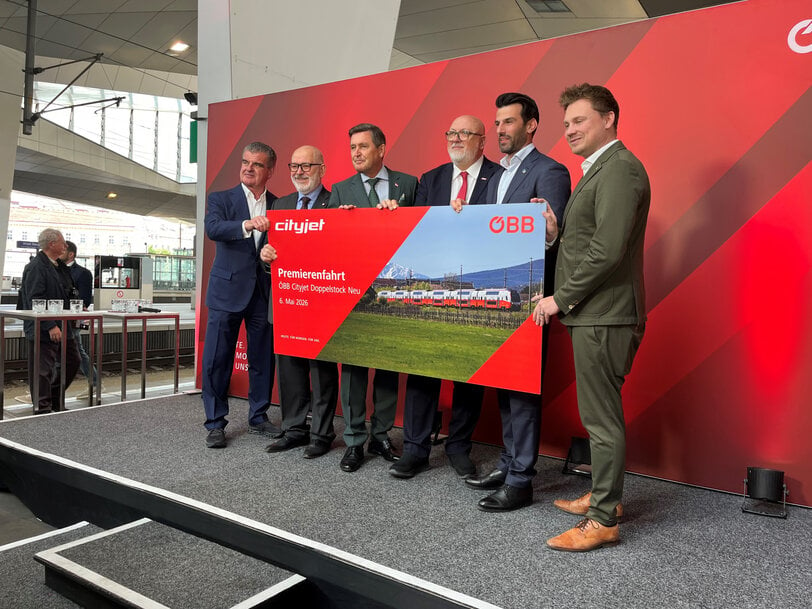
ÖBB and Stadler have launched the first new-generation Cityjet double-decker train for regional passenger operations in Austria. The train completed its inaugural journey from Vienna Central Station to Wiener Neustadt as part of a long-term fleet modernization programme for local and regional rail services.
ÖBB has ordered 109 Cityjet double-decker trains from Stadler under an investment programme valued at approximately €1.5 billion. The deployment forms part of a broader €6.1 billion rail fleet expansion initiative that includes around 330 new trains scheduled for introduction by 2030.
Regional Rail Capacity Expansion
The new Cityjet trains are intended to increase passenger capacity on heavily used commuter and regional rail corridors in eastern Austria, where ÖBB operates the majority of its local rail services.
Initial passenger operations are scheduled to begin at the end of June on the Vienna Floridsdorf–Payerbach/Reichenau route. The trains will primarily operate along the north-south regional corridor connecting destinations including Znojmo, Retz, Břeclav, Vienna, Wiener Neustadt, and Payerbach-Reichenau.
By the end of 2026, ÖBB plans to place 45 of the new trains into service in the eastern region.
Rolling Stock Design and Passenger Systems
The Cityjet platform combines increased seating capacity with low-floor accessibility and updated onboard passenger systems.
The trains are available in four-car and six-car formations with lengths of 107 metres and 160 metres respectively. Seating capacity reaches approximately 371 passengers in the four-car configuration and approximately 591 passengers in the six-car configuration.
The trains have a maximum operating speed of 160 km/h.
Accessibility infrastructure includes low-floor boarding areas, wheelchair spaces with adjustable side tables, accessible toilets, and dedicated multi-purpose areas for bicycles, luggage, and pushchairs.
Passenger systems include real-time onboard information displays, Wi-Fi connectivity, CCTV, USB charging ports, and air-conditioning systems using environmentally compatible refrigerants.
Manufacturing and Rail Modernization
Stadler supplied the rolling stock as part of ÖBB’s ongoing fleet modernization strategy focused on increasing operational capacity, improving passenger accessibility, and reducing environmental impact in regional transport operations.
The double-decker configuration enables higher passenger volumes without requiring additional train paths on congested rail corridors. This approach supports increased rail utilization while maintaining existing infrastructure capacity.
The deployment also reflects broader investment in sustainable public transport systems and modal shift strategies within Austria’s rail sector.
Operational Deployment
The trains will gradually enter service across ÖBB’s eastern regional network following phased operational introduction and fleet integration activities.
The programme is intended to support growing passenger demand in commuter rail services around Vienna and Lower Austria while improving operational flexibility and service frequency on regional routes.
Edited by Natania Lyngdoh, Induportals Editor, with AI assistance.
www.stadlerrail.com
