
railway-international.com
23
'26
Written on Modified on
Circadian Lighting in Rail: A Low-Cost Opportunity Hiding in Plain Sight
Circadian-aware lighting—already established in healthcare and aviation—offers a practical, low-cost opportunity to improve passenger experience, staff wellbeing and overall perception of safety across the rail network.
ivisionuk.com
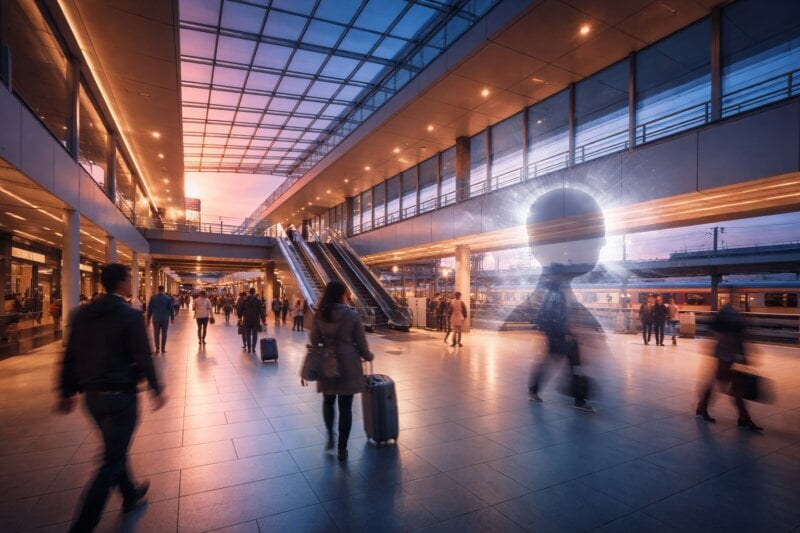
Lighting in the rail environment is often treated as a functional necessity rather than a strategic asset. Yet growing evidence suggests that circadian-aware lighting—already established in healthcare and aviation—offers a practical, low-cost opportunity to improve passenger experience, staff wellbeing and overall perception of safety across the rail network.
From illumination to influence
Over the last two decades, research into human response to light has demonstrated that illumination affects more than visual performance alone. Spectrum, intensity and timing of light exposure influence circadian rhythms, alertness and wellbeing through biological pathways distinct from vision. This understanding underpins international guidance on biologically effective light and has reshaped lighting practice in several safety-critical sectors (CIE S 026/E:2018; Brainard et al.).
In healthcare environments, circadian lighting is now routinely used to support patient recovery and staff alertness, with guidance increasingly reflected in UK health building standards (van Bommel; NHS Health Building Notes). In aviation, dynamic cabin lighting schemes are widely deployed to reduce fatigue and support passenger comfort during irregular or long-haul journeys, with published studies and manufacturer guidance supporting their effectiveness.
Railway environments share many of the same characteristics: extended exposure to artificial light, irregular operating hours, enclosed spaces and a strong dependence on passenger perception of comfort and safety. Yet adoption of circadian lighting within rail infrastructure and rolling stock has been comparatively slow.
The perception gap
A persistent barrier is perception.
Circadian lighting is often assumed to be prohibitively expensive, overly complex or impractical to retrofit into existing facilities. These assumptions may once have been valid, but they are increasingly out of step with current technology.
Advances in LED efficacy, optical design and digital control systems now allow dynamic control of light level and colour temperature with minimal additional cost when compared to conventional LED installations (IEA; ILP guidance). When viewed in the context of typical rail capital projects—new footbridges, station redevelopments, platform extensions or rolling stock programmes—the incremental cost of circadian capability is small.
The timing is particularly relevant in the UK, as Control Period 7 (CP7) brings continued investment in station upgrades, accessibility improvements and asset renewals across the network. Many of these programmes involve footbridge replacements, concourse refurbishments and lighting upgrades driven by energy efficiency, compliance or maintenance considerations. Similarly, rolling stock refurbishment and new train procurement programmes present opportunities to rethink onboard environments in terms of passenger comfort and staff wellbeing. In each case, lighting interventions are already planned—making the marginal step to circadian-capable systems both practical and cost-effective when considered early.
In many cases, it is negligible.
Lighting’s late arrival problem
Despite this, lighting is frequently treated as a secondary package within infrastructure projects. Because it represents a relatively small proportion of overall budgets, lighting design is often deferred until late in the programme, after major architectural and structural decisions have already been fixed.
This approach has consequences.
Studies of pedestrian and transport environments consistently show that lighting quality significantly influences perceived safety, reassurance and comfort—particularly in enclosed or transitional spaces such as subways and footbridges (Boyce; Fotios et al.). When lighting is left until late stages, opportunities to enhance these outcomes are often lost.
Circadian lighting is most effective when considered early, but it does not require complex systems or bespoke solutions. The challenge is rarely technical feasibility—it is timing and prioritisation.
What circadian lighting means in practice
At a practical level, implementing circadian lighting in rail environments is far simpler than many assume.
In existing facilities, circadian capability is typically introduced by upgrading the internal light source of an existing luminaire rather than replacing the entire fitting or environment. LED-based light engines with multiple controllable channels allow independent adjustment of intensity and spectral composition, enabling gradual, programmed changes throughout the day rather than simple on/off switching.
In practice, this usually involves two or three controllable channels, delivering smooth transitions in colour temperature and output that are subtle, predictable and non-distracting. This approach aligns with current understanding of melanopic response and circadian stimulation, which cannot be captured by traditional lux-based metrics alone (Lucas et al.).
External form factors, mounting arrangements and optical distributions can often remain unchanged—an important consideration in constrained or architecturally sensitive rail environments.
Control without disruption
Once luminaires support variable output and spectrum, control strategy becomes the key consideration.
In rail applications, circadian lighting is commonly driven by:
. time-of-day schedules aligned with natural daylight cycles, and/or
. sensor inputs such as ambient light levels or occupancy.
The objective is not constant optimisation, but steady, gradual change—for example:
. cooler, higher-alertness light during early morning peak periods,
. neutral tones during daytime operation, and
. warmer, lower-intensity light during evening and night-time hours.
Modern wireless lighting control systems allow these capabilities to be integrated into existing facility management or lighting control platforms without extensive rewiring. For retrofit projects in live stations, this significantly reduces installation time, disruption and cost.
Similar approaches have already been implemented in transport-adjacent and operational environments where lighting upgrades were driven primarily by efficiency and maintenance considerations. In these cases, the introduction of multi-channel LED luminaires and wireless control allowed circadian lighting profiles to be implemented without additional structural work or disruption to operations. The result was infrastructure that not only reduced energy consumption and maintenance burden but also delivered a more consistent and reassuring passenger environment throughout the operating day.
Why rail environments are particularly well suited
Certain rail environments are especially well matched to circadian lighting approaches.
Footbridges are transitional spaces, often enclosed and frequently used at early or late hours. Research into pedestrian reassurance indicates that appropriate lighting can materially influence perceived safety and comfort in such environments (Fotios et al.).
Concourses and circulation areas are occupied for longer periods and experience predictable daily rhythms. These spaces benefit from lighting that complements available daylight and provides subtle visual cues as conditions change.
Trains and onboard environments represent a largely untapped opportunity. Passengers and staff may spend extended periods under artificial light, sometimes disconnected from external time cues. Studies in transport-adjacent environments suggest that circadian-aware lighting can improve comfort and reduce fatigue, particularly during extended or irregular journeys (Spitschan; aviation case studies).
Keeping complexity proportional
Evidence from healthcare and aviation highlights the importance of restraint. Circadian lighting does not require continuous adjustment or overly granular control to be effective. In most applications, simple profiles—agreed early and commissioned carefully—deliver the majority of benefits.
The emphasis should be on alignment between lighting design, operational patterns and human use of space, rather than technological ambition.
A question of value
As the rail industry continues to focus on whole-life cost, passenger experience and staff wellbeing, it is worth asking whether lighting is being asked to do enough.
Circadian lighting is not about novelty or visual effect. It is about recognising that light influences human behaviour and perception, and that rail environments—stations, footbridges and trains—are uniquely positioned to benefit from that understanding.
As the rail industry enters a period of continued asset renewal and investment under CP7, there is increasing focus on whole-life value, passenger experience and operational efficiency. Lighting upgrades will form part of many of these programmes, whether driven by compliance, accessibility, maintenance or energy performance.
The question is not whether lighting will be replaced—but whether it will be replaced in a way that captures its full potential.
Circadian-capable lighting can be delivered using mature, reliable technology, often with minimal incremental cost when incorporated at the point of upgrade or specification. By contrast, overlooking this opportunity may lock infrastructure into decades of static lighting that fails to reflect modern understanding of human response to light.
Lighting is one of the few infrastructure systems that directly affects every passenger and member of staff, every day. Treating it as a strategic asset rather than a functional afterthought offers a practical and proportionate means to enhance passenger experience, support staff wellbeing and improve the perceived quality of railway environments.
As rail continues to compete with other modes of transport on comfort, experience and accessibility, the role of lighting deserves renewed attention—not as an aesthetic consideration, but as a core component of human-centred infrastructure.
www.ivisionuk.com
