
Integrated Linear Lighting Improves Safety on Dumfries Station Footbridge
Modern railway footbridges demand lighting solutions that balance passenger safety, compliance and architectural integration.
ivisionuk.com
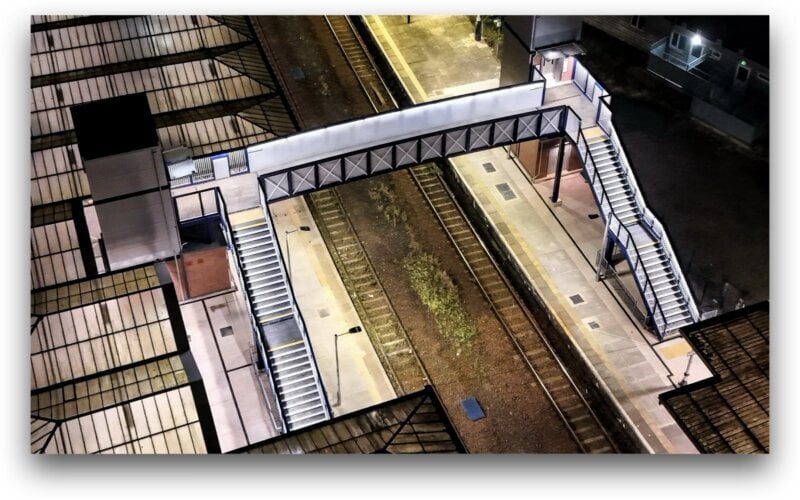
A passenger bridge completed at Dumfries Station in 2024 demonstrates how low-voltage linear lighting can meet these requirements within the constrained environments typical of rail infrastructure.
Lighting railway footbridges presents a unique set of challenges for designers and infrastructure engineers. Installations must deliver clear, uniform illumination for passenger safety while operating within tight architectural spaces and complying with stringent electrical standards for public environments.
At Dumfries Station in Scotland, a passenger footbridge completed in 2024 illustrates how modern low-voltage linear lighting can meet these requirements while integrating seamlessly with contemporary station architecture.
Opened to passengers in April 2024, the bridge forms an important link between platforms, with stairways, lift towers and a central enclosed walkway providing the primary circulation route for passengers. Ensuring these areas are safely illuminated at all times was a key requirement of the project, particularly given the complex geometry of the structure and the need to minimise visual clutter within the bridge enclosure.
The lighting design therefore focused on delivering consistent, glare-free illumination along walking routes and stair treads without introducing bulky fittings that would interfere with the bridge’s architectural form.
Designing for constrained railway environments
Passenger footbridges often provide limited space for traditional lighting equipment. Structural elements such as bridge cowls, handrails and stair stringers can leave very little clearance for conventional luminaires.
To address this, a low-profile linear LED system was selected that could be integrated directly into the bridge structure. By mounting the luminaires along circulation routes rather than overhead, the installation provides a continuous line of light that clearly defines passenger pathways while maintaining a clean architectural appearance.
Careful optical control was also important. In enclosed pedestrian bridges, visible LED points or poorly controlled lighting can create glare or reflections that affect passenger comfort. A diffused optical system was therefore used to ensure the light appears as a smooth, uniform line rather than individual LED sources, helping eliminate hotspotting and shadowing along stairs and walkways.
Meeting railway safety requirements
Lighting within passenger-accessible railway environments must comply with strict electrical and mechanical standards. For the Dumfries bridge, the system was designed in accordance with RIS-7702-INS, the railway industry standard governing lighting installations in stations and passenger areas.
One of the key requirements is the use of SELV (Safety Extra-Low Voltage) electrical systems, typically operating in the 24–48 V DC range. These systems reduce electrical risk in publicly accessible environments while supporting safer installation and maintenance.
Durability is equally critical for infrastructure exposed to weather, vibration and occasional impact. To withstand these conditions, the luminaires specified for the bridge incorporate high levels of environmental protection, including resistance to water ingress, dust and mechanical impact.
This ensures the installation can maintain reliable operation despite the demanding conditions typically encountered in railway environments.
Delivering uniform illumination
Consistent lighting levels across both walkways and stairs are essential for passenger safety, particularly in high-traffic environments where uneven lighting can obscure step edges or create shadowed areas.
During installation at Dumfries Station, the luminaires were mounted using angled carriers that orient the light beam towards both horizontal walking surfaces and vertical stair treads. This approach allows a single linear lighting run to illuminate multiple surfaces effectively, producing balanced illumination across the entire circulation route.
The system also incorporates dimming capability, enabling operators to adjust light output where appropriate to balance operational requirements with energy efficiency.
Efficient installation and long-term performance
Installing lighting equipment on footbridges often involves working within restricted structural spaces. To simplify installation, electrical connections on the Dumfries bridge were completed using insulation displacement connectors, allowing cables to be terminated quickly without extensive preparation.
Cabling was routed through integrated carriers within the luminaires themselves, helping maintain a clean appearance while also improving safety and resistance to vandalism.
The finished installation now provides evenly distributed illumination across the bridge structure, improving visibility on stairs and landings while reducing shadowing along passenger routes.
In addition, the sealed construction of the lighting system helps minimise maintenance requirements, reducing the need for regular resealing or component replacement compared with older lighting technologies.
Lighting for evolving rail infrastructure
As stations across the rail network continue to be modernised, lighting is increasingly expected to fulfil multiple roles: ensuring passenger safety, supporting architectural integration and reducing long-term maintenance demands.
Low-voltage linear lighting approaches, such as those used at Dumfries Station, demonstrate how these requirements can be achieved within the constraints typical of railway infrastructure. By combining compliant SELV operation, durable construction and carefully controlled optical performance, such systems provide reliable illumination while supporting the long-term operational needs of modern rail environments.
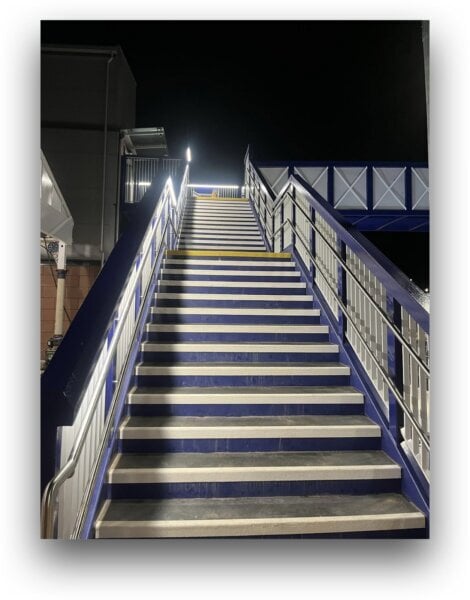
Figure: Linear LED luminaires integrated into the stair structure of the Dumfries Station passenger footbridge provide uniform illumination while maintaining a clean architectural appearance.
© i-Vision Lighting Solutions
www.ivisionuk.com
