
Sensor Innovation to Leap Forward the Mobility of People and Goods
To ensure and expand sustainable mobility solutions, the transport of passengers and cargo requires high-performing, seamlessly integrated monitoring and control systems.
www.asc-sensors.de
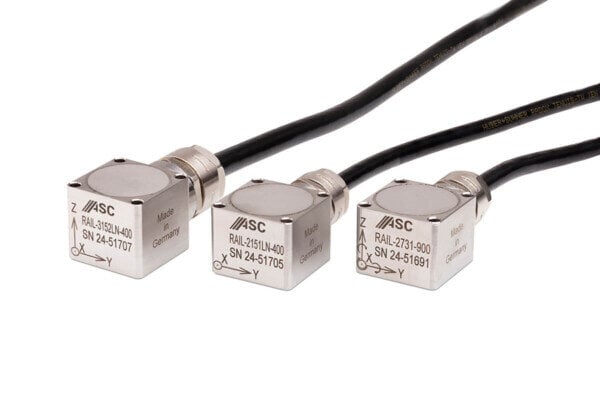
High-capacity transportation links can be maximized through automated 24/7 sensor supervision, real-time analyses and predictive maintenance alerts and actions.
To facilitate a bright future for rail and infrastructure providers and address their specific challenges, ASC Sensors recently launched new, cutting-edge inertial sensor systems. The ASC QBA and ASC RAIL series have been evaluated in major industry partnerships and are now available for broad application. They can help rail and infrastructure operators cut down significantly on individual documentation and other efforts, while achieving gains in traffic volumes, efficiencies and cost savings.
ASC QBA series: highest precision in structural health monitoring
ASC QBA quartz series
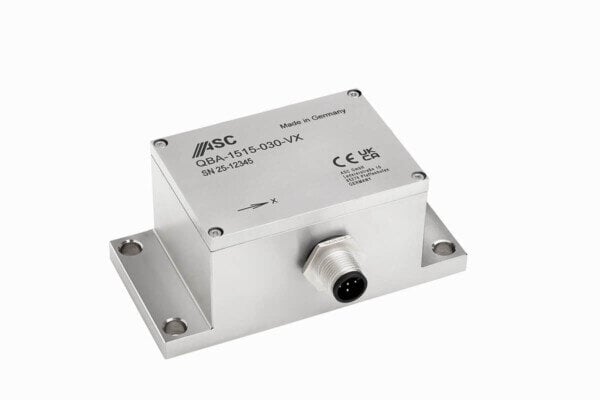
Earlier this year, ASC QBA servo-balanced quartz accelerometers were developed for and integrated into a massive UK railway viaduct that forms a critical component of a new high-speed rail link. As the latter puts considerable strain on the 2.1-mile long, gently curving structure, precision instrumentation and constant monitoring are critical. ASC’s high-performance quartz accelerometers are installed at defined measuring points in the deck segments and noise barriers of the bridge to ensure smooth, safe, stable operation under extreme stress loads.
What resulted from this collaboration is the customisable ASC QBA series: uniaxial quartz accelerometers for highest precision in structural health monitoring, configured to the needs of bridge and infrastructure operators. They are readily available in vertical-mounted, uniaxial VX, VY or VZ sensitive directions. Based on proven, high-performance servo-balanced quartz sensing elements, ASC QBA accelerometers feature a measurement range of ±30 g. A resolution of better than 1 μg enables the detection of even smallest vibrations. They offer outstanding long-term stability of the scale factor (K1: 1200 ppm) and bias (K0: 1200 μg), too. On demand, biaxial and triaxial accelerometers as well as smaller measuring ranges down to ±1 g are available.
ASC’s QBA series can be adapted to fit application-specific housings of protection class IP67. The upgraded electronic circuitry utilizes flexible power supply of 9-36 VDC and a 4-20 mA analog current output for reliable data transmission. The sensors provide accuracy and long-term stability at temperatures from -40°C to +70°C and can be leveraged from the arctic circles to the world’s deserts. Beyond bridge monitoring and civil engineering, they are of value in a wide range of further high-end measurement applications including train vibration and tilt control, conveying systems, seismic detection, automotive testing or navigation systems in the aviation and aerospace industries.
Pre-qualified sensor solutions to propel railway performance
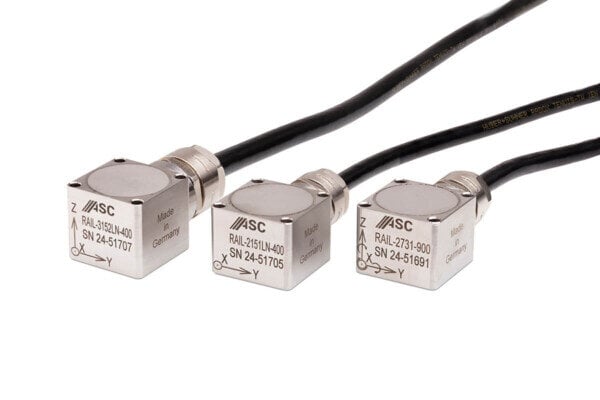
Another ASC innovation in specific support of efficient railway networks is the ASC RAIL series. Uni-, bi- and triaxial capacitive accelerometers and gyroscopes are used to enable condition monitoring of the bogie components and to acquire the running characteristics of in-service railway vehicles. Therefore, they have been qualified in accordance with EN 50155 (climatic resistance and dynamic-mechanical robustness), EN 50121 (electromagnetic compatibility) and meet the latest fire protection standards including EN 45545 for electronic equipment on rolling stock. This includes a robust, non-flammable, stainless-steel IP68 housing as well as rail-certified cables and cable glands.
Renate Bay, CEO of ASC Sensors, said:
"With the rigorous testing and documentation of our RAIL sensor series’ performance, we’re making it significantly easier for operators to realize custom sensor systems on their rolling stock. They can rely on a proven set of stable precision sensors that meet all applicable national and international standards, ready for installation."
The ASC RAIL series is extremely versatile. By combining accelerometer and gyroscope sensor elements, an integrated sensor system featuring up to three degrees of freedom can be tailored with adjustable measurement ranges. Considering all possible variations, this leads to the most flexible precision sensor ‘toolbox’ readily available for installation.
Bay states:
"Rail system integrators can now mix and match from ASC’s RAIL series’ components to build customised solutions meeting their unique needs. This saves significant effort, time and budget while strengthening the safety, capacity and productivity of rail networks."
Digital and smart RAIL solutions
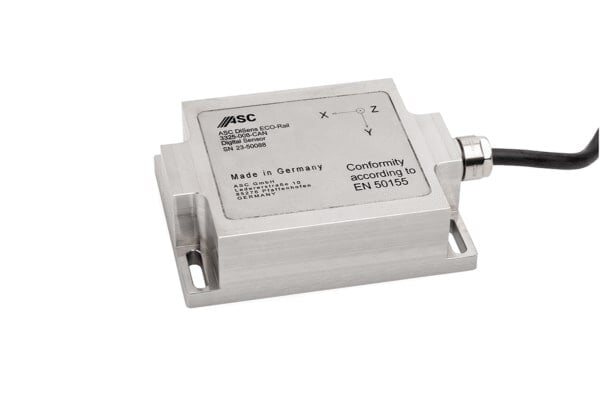
The ASC RAIL series includes digital sensors and smart sensor systems, too. ASC DiSens® ECO-RAIL digital accelerometers are based on proven MEMS technology and capacitive operating principle. The integrated electronic circuitry provides enhanced protection through galvanically isolated main parts for power supply, sensing and the digital CAN interface. Integrated filter settings enable a sampling rate of up to 4 kHz at a 3dB-corner frequency of 1 kHz as well as configurable measurement range settings of ±2/4/8 g or ±10/20/40 g.
ASC AiSys® ECO-RAIL smart sensor systems integrate the user-friendly specs of digital accelerometers with complex mathematical algorithms. For example, this includes frequency analysis through FFT and calculating dynamic velocity and displacement.
Pushing ahead through innovation
Bay says:
"At ASC, leapfrog sensor innovation typically comes from close customer collaboration. The best ideas usually come from bringing diverse perspectives to a tough problem – often something no one ever tried solving before. ASC will then create a customized solution. However, even better when those innovations become accessible to others in the market, too. Our rapidly growing world needs strong mobility assets. The ASC team partners with customers around the globe to create those."
www.asc-sensors.de
