
railway-international.com
25
'26
Written on Modified on
Stadler Showcases Low-Floor TINA Tram at InnoTrans 2026
Integrated sub-floor powertrain and pivoting bogie architectures eliminate interior steps and ramps across urban passenger transit networks.
stadlerrail.com
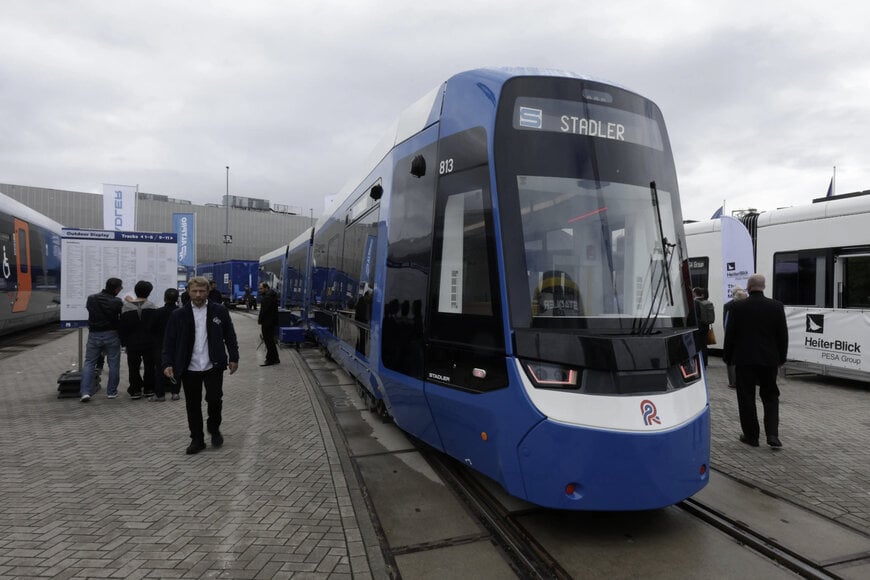
Stadler presented its TINA tram platform configured for municipal transit operator Rostocker Straßenbahn AG. The rolling stock design targets urban light-rail networks by housing all propulsion, braking, and running assemblies entirely beneath the vehicle floor to maximize interior accessibility.
Trade Fair Presentation and Regional Delivery Schedules
Stadler showcased the tram at the InnoTrans international transport technology exhibition in Berlin, Germany. The display vehicle represents the three-section configuration built for Rostocker Straßenbahn AG under a fleet procurement contract for 30 units. Twelve vehicles from the series are already operating across the municipal transit network in Rostock, Germany, with the remaining trainsets scheduled for phased delivery.
Sub-Floor Drive Engineering and Kinetic Running Gear
The platform relies on the Total Integrated Low-Floor Drive vehicle architecture, which packages traction motors, mechanical braking units, and guidance gear beneath the primary passenger deck. By positioning all drive hardware underneath the passenger compartment, the layout eliminates raised platforms, steps, and interior ramps typically required above driven wheelsets.
Four specialized bogies distribute axle loads to minimize mechanical friction and flange wear along rails and wheels during curved track negotiation. Dr. Ansgar Brockmeyer, Executive Vice President of Sales and Marketing at Stadler, stated that integrating the entire drive layout beneath the floor allows spatial optimization to directly govern the passenger interior.
Passenger Capacity, Cabin Kinematics, and Driver Support Systems
The three-car articulated tram measures approximately 32 meters in length and accommodates up to 216 passengers, including 75 seated positions. The passenger saloon features high ceilings, panoramic glazing, Wi-Fi connectivity, USB charging outlets, dual TFT digital passenger information displays, and four multifunction areas configured for wheelchairs, strollers, and bicycles.
The driver cabin incorporates an ergonomic control environment paired with active driver assistance technology, including an optical and sensor-based collision protection system. Jan Bleis, Executive Board Member for Market and Technology at Rostocker Straßenbahn AG, stated that fleet modernization focuses on long-term technological reliability and passenger adoption, while Yvette Hartmann, Executive Board Member for Commercial Affairs, noted that the flat floor and expanded sightlines directly support municipal accessibility goals.
Additional Context:
This section details technical specifications and competitive benchmarking not included in the original product announcement
Modern 100 percent low-floor light-rail vehicles are benchmarked against entrance height, interior floor topography, wheelset pivot capabilities, and track wear characteristics. A significant engineering challenge in low-floor tram design is avoiding interior pedestal ramps while retaining pivoting bogies that minimize lateral track forces.
Stadler TINA competes directly with multi-articulated and modular platforms including the Alstom Citadis and Siemens Avenio. Alstom Citadis trams, such as the Citadis 302 and 305 series, traditionally utilize fixed bogies positioned beneath short carbody sections. While fixed bogies simplify sub-floor mechanical packaging, they generate higher lateral flange forces against the rail head in tight track curves (below 20-meter radii), typically accelerating wheel profile degradation and necessitating track lubrication systems.
Siemens Avenio addresses wheel-rail wear through a multi-articulated layout using single-bogie short modules where each section rests on a pivoting, gearless or geared bogie with independent wheels. This design achieves a low floor height of approximately 350 to 380 millimeters above top-of-rail, but requires articulated joints between short car segments.
The Stadler TINA platform differentiates itself by pairing conventional continuous axles and pivoting bogies with a step-free interior that maintains a 370-millimeter passenger deck height across the entire vehicle aisle without exceeding 10 percent longitudinal floor slopes. By combining pivoting bogies with true axle assemblies rather than stub axles, TINA maintains high running stability at its 70 to 80 kilometer-per-hour design speed while reducing rail wear rates compared to fixed-bogie configurations.
Edited by Natania Lyngdoh, Induportals editor, assisted by AI.
www.stadlerrail.com
