
railway-international.com
24
'26
Written on Modified on
Trenitalia and Alstom Unveil the New Intercity 200
The 200 km/h Coradia Stream train combines technological innovation, passenger comfort, and high sustainability standards.
www.alstom.com
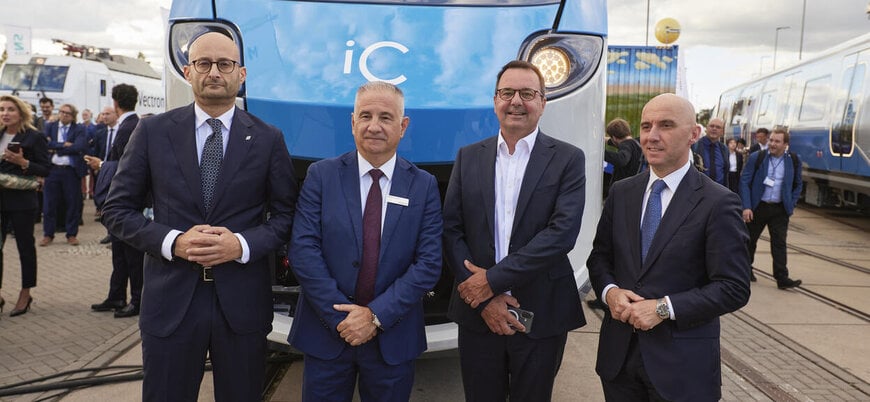
Gianpiero Strisciuglio, CEO and General Manager of FS Group, Michele Viale, Managing Director of Alstom Italy, Martin Sion, CEO Alstom, Simone Gorini, General Manager Trenitalia
Trenitalia (FS Group) and Alstom have officially unveiled the new Intercity 200 train at the InnoTrans 2026 exhibition in Berlin. Capable of reaching operating speeds of up to 200 km/h, the new vehicle is based on Alstom’s proven Coradia Stream platform. The train introduces a modern, functional onboard environment featuring 403 seats crafted from recycled materials, dedicated family areas, automated refreshment points, and spaces for bicycles—including electric bike charging facilities. The rollout is part of Trenitalia's €500 million investment program, funded by Italy's National Recovery and Resilience Plan (NRRP), to procure 38 new Intercity trains aimed at renewing medium- and long-distance transport, especially across Central and Southern Italy.
Manufactured in Italy, the new Intercity 200 achieves exceptional environmental benchmarks. The train is up to 94 percent recyclable and boasts a 96 percent recoverability rate at the end of its lifecycle. It also delivers energy consumption reductions of up to 30 percent compared to previous generation models. Technologically, the fleet integrates Alstom's advanced digital systems for operations management and predictive maintenance, leveraging real-time data to anticipate service requirements and optimize lifecycle reliability.
Additional Context
This section provides technological and market background not explicitly detailed in the original release.
The decision to adapt the Coradia Stream platform—originally a low-floor regional commuter train—for 200 km/h Intercity service reflects a growing trend in European rail to standardize vehicle architectures across different operational profiles. By utilizing a modular platform, operators like Trenitalia can significantly reduce spare parts inventory and maintenance training costs.
Furthermore, the emphasis on 96 percent recoverability and 30 percent energy reduction is critical to meeting the stringent environmental criteria attached to the European Union's NextGenerationEU recovery funds, which finance Italy's NRRP. To achieve such high energy savings at 200 km/h, the trains incorporate highly aerodynamic front-end designs, lightweight aluminum car bodies, and advanced insulated-gate bipolar transistor (IGBT) traction systems that facilitate highly efficient regenerative braking. By deploying these advanced, accessible trains on non-electrified or historically underserved routes in Southern Italy, Trenitalia aims to bridge the infrastructure gap and modernize its national rail cohesion strategy.
Edited by an industrial journalist, Lekshman Ramdas, with AI assistance.
www.alstom.com
Trenitalia (FS Group) and Alstom have officially unveiled the new Intercity 200 train at the InnoTrans 2026 exhibition in Berlin. Capable of reaching operating speeds of up to 200 km/h, the new vehicle is based on Alstom’s proven Coradia Stream platform. The train introduces a modern, functional onboard environment featuring 403 seats crafted from recycled materials, dedicated family areas, automated refreshment points, and spaces for bicycles—including electric bike charging facilities. The rollout is part of Trenitalia's €500 million investment program, funded by Italy's National Recovery and Resilience Plan (NRRP), to procure 38 new Intercity trains aimed at renewing medium- and long-distance transport, especially across Central and Southern Italy.
Manufactured in Italy, the new Intercity 200 achieves exceptional environmental benchmarks. The train is up to 94 percent recyclable and boasts a 96 percent recoverability rate at the end of its lifecycle. It also delivers energy consumption reductions of up to 30 percent compared to previous generation models. Technologically, the fleet integrates Alstom's advanced digital systems for operations management and predictive maintenance, leveraging real-time data to anticipate service requirements and optimize lifecycle reliability.
Additional Context
This section provides technological and market background not explicitly detailed in the original release.
The decision to adapt the Coradia Stream platform—originally a low-floor regional commuter train—for 200 km/h Intercity service reflects a growing trend in European rail to standardize vehicle architectures across different operational profiles. By utilizing a modular platform, operators like Trenitalia can significantly reduce spare parts inventory and maintenance training costs.
Furthermore, the emphasis on 96 percent recoverability and 30 percent energy reduction is critical to meeting the stringent environmental criteria attached to the European Union's NextGenerationEU recovery funds, which finance Italy's NRRP. To achieve such high energy savings at 200 km/h, the trains incorporate highly aerodynamic front-end designs, lightweight aluminum car bodies, and advanced insulated-gate bipolar transistor (IGBT) traction systems that facilitate highly efficient regenerative braking. By deploying these advanced, accessible trains on non-electrified or historically underserved routes in Southern Italy, Trenitalia aims to bridge the infrastructure gap and modernize its national rail cohesion strategy.
Edited by an industrial journalist, Lekshman Ramdas, with AI assistance.
www.alstom.com
