
railway-international.com
31
'26
Written on Modified on
Hitachi Rail Signalling Powers New Thessaloniki Metro Extension
The 4.8 km Kalamaria extension adds five driverless stations utilizing advanced GoA4 CBTC technology to enhance urban mobility.
www.hitachirail.com
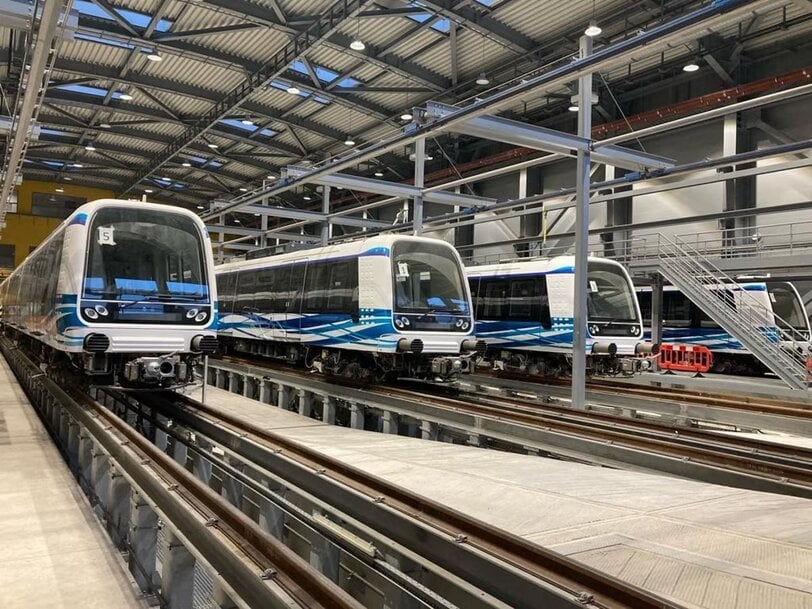
The Kalamaria extension of the Thessaloniki metro in Greece officially entered service, utilizing Hitachi Rail's Communications Based Train Control (CBTC) signalling technology. The 4.8-kilometer underground section branches from the existing network at the 25 Martiou station and adds five new driverless stations: Nomarchia, Kalamaria, Aretsou, Nea Krini, and Mikra. As the latest phase in the expansion of Greece's first fully automated rapid transit system, the extension aims to improve sustainable urban mobility and provide reliable transportation across eastern Thessaloniki.
The integration of the advanced digital signalling system enables Grade of Automation 4 (GoA4) operations, allowing for completely driverless train services with high safety and operational efficiency. Delivered through a joint venture involving Hitachi Rail and Aktor, the new line connects seamlessly with the existing 9.6-kilometer baseline originally constructed by the AIASA consortium, which included Aktor, Webuild, and Hitachi Rail. According to a Hitachi Rail spokesperson, deploying the proven CBTC technology supports the city's transition to a more sustainable, low-emission transportation network.
Additional Context
This section provides technological and market background not explicitly detailed in the original release.
The Thessaloniki Metro's deployment of Grade of Automation 4 (GoA4) represents the highest level of train automation, where the system autonomously handles starting, stopping, door operations, and emergency responses without any onboard staff. The core of this capability is the Communications-Based Train Control (CBTC) system, which uses continuous, two-way radio communication between the trains and trackside equipment to determine precise train locations and dynamically adjust speeds. By eliminating the fixed-block spacing used in traditional railways, CBTC allows trains to run at much tighter headways, significantly increasing passenger throughput safely during peak hours. For Thessaloniki, a city historically challenged by severe road congestion, the driverless network reduces surface traffic and overall carbon emissions, offering a modern mobility solution that aligns closely with the European Union's regional cohesion and sustainability funding goals.
Edited by Nicolas Bony, Induportals editor – adapted by AI.
www.hitachirail.com
