
railway-international.com
18
'26
Written on Modified on
Low-Carbon Concrete in Urban Rail Infrastructure
Holcim supplies low-carbon concrete solutions for Melbourne Metro Tunnel to reduce embodied carbon while maintaining structural performance in large-scale underground transport systems.
www.holcim.com.au
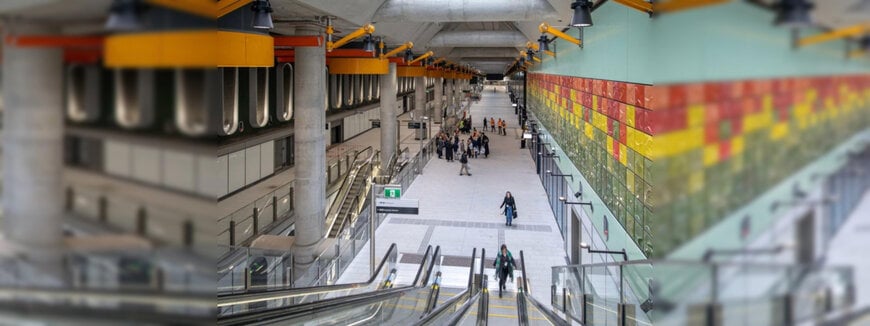
Melbourne’s Metro Tunnel Project integrates low-carbon concrete technologies to reduce emissions associated with large-scale underground construction while maintaining the structural integrity required for urban rail infrastructure.
Infrastructure Demand and Embodied Carbon Challenges
The Melbourne Metro Tunnel Project, one of Australia’s largest public transport developments, involves the construction of twin 9 km rail tunnels and five underground stations to expand the city’s electrified rail network. Such infrastructure is central to reducing urban transport emissions by enabling modal shifts from private vehicles to high-capacity rail systems.
However, tunnel and station construction requires significant volumes of concrete, a major contributor to embodied carbon due to cement production. In parallel, the project addressed resource constraints, particularly the global demand for industrial sand, a key input in concrete production.
Low-Carbon Concrete Mix Design and Material Optimization
Over a five-year construction period, Holcim supplied more than 600,000 cubic metres of ready-mix concrete for the tunnel and station structures. A total of 45 specialised concrete mixes were developed to meet varying geotechnical and structural requirements.
A key strategy involved increasing the proportion of supplementary cementitious materials (SCMs) in the mixes. This enabled a 52% reduction in Portland cement content across multiple applications, directly lowering the carbon intensity of the concrete while maintaining required compressive strength and durability for underground environments.
These formulations are now part of Holcim’s ECOPact range, designed for use in projects requiring reduced embodied carbon without compromising engineering performance.
Circular Materials: Recycled Glass as Sand Replacement
To address raw material consumption, Holcim collaborated with the University of Melbourne and industry partners to develop a structural-grade concrete incorporating processed recycled glass.
The mix replaces 25% of conventional virgin sand with crushed recycled glass. Performance testing confirmed no reduction in structural properties, enabling its use in temporary blinding slabs during construction of the State Library Station.
This represents a first application of recycled glass in structural-grade concrete at major infrastructure scale. Previous uses of such materials were typically limited to non-structural applications such as pavements and local roadworks, indicating a shift toward a more circular construction model within the broader digital supply chain of infrastructure materials.
Emissions Reduction and System-Level Impact
The implementation of low-carbon and circular concrete solutions contributed to an estimated reduction of approximately 150,000 tonnes of CO₂ emissions across the project. This reduction is comparable to the annual emissions of more than 8,500 households.
Beyond construction-phase impacts, the completed Metro Tunnel is expected to increase network capacity by up to 500,000 additional passengers per week during peak periods. By supporting electrified rail transport, the project contributes to long-term emissions reduction across Melbourne’s urban mobility system.
Implications for Circular Construction Practices
The Melbourne Metro Tunnel Project demonstrates the feasibility of integrating low-carbon concrete and recycled materials into large-scale infrastructure without compromising structural requirements. The use of SCMs and recycled aggregates aligns with broader industry efforts to reduce reliance on carbon-intensive inputs and finite natural resources.
Such approaches illustrate how material innovation can support the transition toward lower-emission construction practices, particularly in complex underground environments where performance criteria remain stringent.
Edited by an industrial journalist, Sucithra Mani, with AI assistance.
www.holcim.com
