
railway-international.com
02
'26
Written on Modified on
indie to showcase imaging radar for rail safety at InnoRail India 2026
The advanced MIMO radar evaluation platform aims to enhance railway infrastructure monitoring and rolling stock security.
www.indie.inc
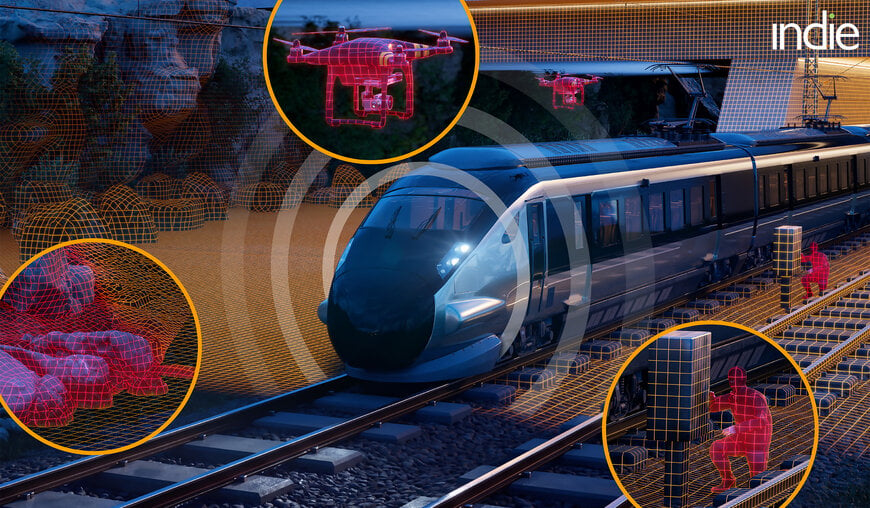
Imaging radar opens up new possibilities for monitoring railway lines and their surroundings – from environmental hazards such as landslides to drones and unauthorized interference with rail infrastructure.
indie, a global leader in automotive and industrial semiconductor solutions, will present its latest radar technologies at InnoRail India 2026, held from November 26–28 in Lucknow. Exhibiting at Booth 10.4 in the German Pavilion, the company will demonstrate how advanced imaging radar can significantly augment existing monitoring technologies across railway infrastructure and rolling stock. Potential applications for the technology include monitoring vulnerable track sections for environmental changes, detecting unauthorized access in critical areas, and enhancing overall rail network resilience.
Development partnerships and MIMO technology
To bridge the gap between raw sensor data and actionable operational intelligence, indie is actively seeking partnerships with Indian railway operators and technology providers. At the core of this initiative is the AVR-QDM-110 Eval Kit, a highly configurable Multiple-Input Multiple-Output (MIMO) radar evaluation platform designed to help developers tailor hardware and software to specific use cases, such as railroad crossing monitoring. Building on decades of proven reliability in harsh industrial environments like crane safety and bulk material handling, indie will also feature a technology demonstrator at the event showcasing contactless vibration measurement using 120 GHz radar frequencies.
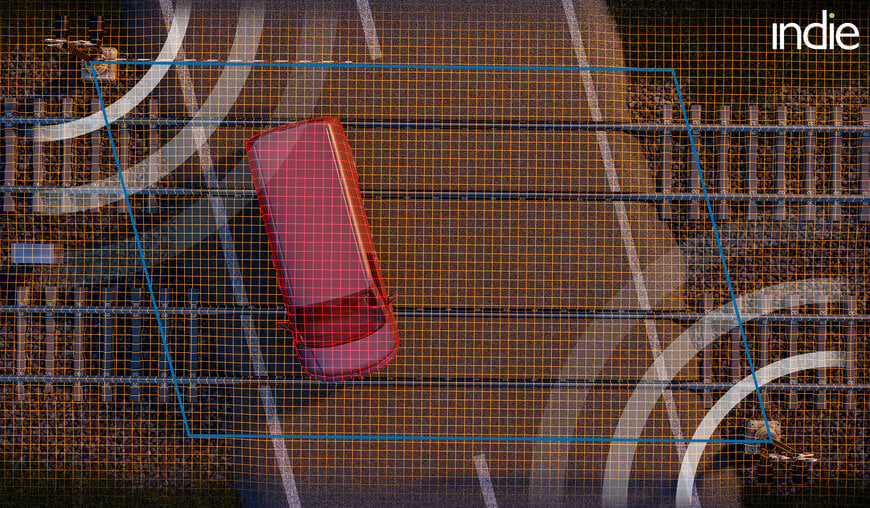
Imaging radar can provide reliable, continuous monitoring of level-crossings, even under challenging weather and visibility conditions.
Additional Context: MIMO radar architecture and environmental resilience
This section details radar signal processing principles not included in the original press release.
Unlike traditional radar systems that emit a single broad beam to detect the simple presence and distance of a target, imaging radar utilizes Multiple-Input Multiple-Output (MIMO) antenna arrays. By simultaneously transmitting and receiving multiple phase-shifted signals across a grid of microscopic antennas, MIMO radar acts as a computational lens. The system processes the resulting phase differences in the returning echoes (using advanced algorithms like Fast Fourier Transforms) to calculate the precise elevation, azimuth, and Doppler velocity of hundreds of simultaneous targets, creating a high-resolution 3D point cloud of the environment. In the rail sector, this capability is revolutionary because, unlike LiDAR or optical cameras, 120 GHz millimeter-wave (mmWave) radar signals easily penetrate heavy rain, dense fog, snow, and dust without degrading. This ensures that safety-critical systems—such as obstacle detection at unmanned level crossings or track deformation monitoring—remain fully operational regardless of extreme environmental conditions.
Edited by an industrial journalist, Lekshman Ramdas, with AI assistance.
www.symeo.com
indie, a global leader in automotive and industrial semiconductor solutions, will present its latest radar technologies at InnoRail India 2026, held from November 26–28 in Lucknow. Exhibiting at Booth 10.4 in the German Pavilion, the company will demonstrate how advanced imaging radar can significantly augment existing monitoring technologies across railway infrastructure and rolling stock. Potential applications for the technology include monitoring vulnerable track sections for environmental changes, detecting unauthorized access in critical areas, and enhancing overall rail network resilience.
Development partnerships and MIMO technology
To bridge the gap between raw sensor data and actionable operational intelligence, indie is actively seeking partnerships with Indian railway operators and technology providers. At the core of this initiative is the AVR-QDM-110 Eval Kit, a highly configurable Multiple-Input Multiple-Output (MIMO) radar evaluation platform designed to help developers tailor hardware and software to specific use cases, such as railroad crossing monitoring. Building on decades of proven reliability in harsh industrial environments like crane safety and bulk material handling, indie will also feature a technology demonstrator at the event showcasing contactless vibration measurement using 120 GHz radar frequencies.
Imaging radar can provide reliable, continuous monitoring of level-crossings, even under challenging weather and visibility conditions.
Additional Context: MIMO radar architecture and environmental resilience
This section details radar signal processing principles not included in the original press release.
Unlike traditional radar systems that emit a single broad beam to detect the simple presence and distance of a target, imaging radar utilizes Multiple-Input Multiple-Output (MIMO) antenna arrays. By simultaneously transmitting and receiving multiple phase-shifted signals across a grid of microscopic antennas, MIMO radar acts as a computational lens. The system processes the resulting phase differences in the returning echoes (using advanced algorithms like Fast Fourier Transforms) to calculate the precise elevation, azimuth, and Doppler velocity of hundreds of simultaneous targets, creating a high-resolution 3D point cloud of the environment. In the rail sector, this capability is revolutionary because, unlike LiDAR or optical cameras, 120 GHz millimeter-wave (mmWave) radar signals easily penetrate heavy rain, dense fog, snow, and dust without degrading. This ensures that safety-critical systems—such as obstacle detection at unmanned level crossings or track deformation monitoring—remain fully operational regardless of extreme environmental conditions.
Edited by an industrial journalist, Lekshman Ramdas, with AI assistance.
www.symeo.com
