
railway-international.com
22
'26
Written on Modified on
Thermal Analysis Software for Predictive Railway Track Maintenance
Vossloh introduces a digital track assessment system designed to calculate thermal stress limits and mitigate buckling risks across modern railway infrastructure.
www.vossloh.com

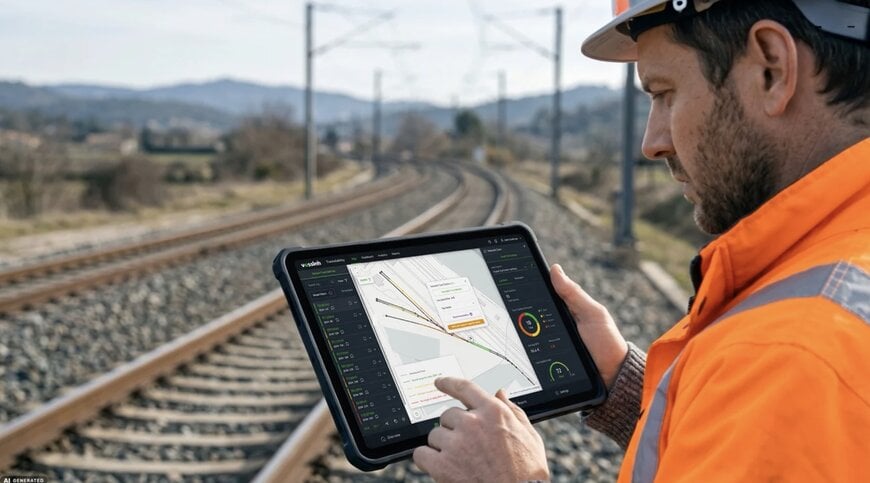
Vossloh is launching the TrackStability software platform to evaluate critical temperature and speed thresholds for localized railway track sections. This digital monitoring solution enables infrastructure operators to proactively manage thermal stress risks across local public transport, conventional transit, high-speed rail, and heavy goods networks.
Mitigating Thermal Deformation Risks
During periods of high ambient heat, continuous welded steel rails absorb significant thermal energy, generating longitudinal compressive forces. When these forces exceed the lateral restraint capacity of the ballast and sleeper matrix, the rails can deform laterally, creating a hazardous structural condition known as track buckling. The TrackStability software models these exact mechanical limits by processing environmental, operational, and material data.
By calculating the precise thermal and speed tolerances of individual track segments, the system allows railway operators to enforce targeted operational adjustments, such as localized speed restrictions, rather than blanket network slowdowns. Addressing the operational impact of this technology, Oliver Schuster, CEO of Vossloh AG, notes, “We can identify risks earlier and more accurately and derive targeted measures from them.” This methodology directly increases the safety and availability of existing rail networks by averting structural failure.
Consolidating Predictive Track Maintenance
The deployment of the TrackStability system reflects a broader industry shift toward a comprehensive railway data ecosystem. The developer is centralizing its digital condition-monitoring applications within a unified access portal, known as the connect platform. Showcased at the InnoTrans trade fair in Berlin from September 22 to 25, 2026, this system architecture treats rail infrastructure as an interconnected data network rather than a series of isolated mechanical components. The exhibition installation also features an artificial intelligence-supported avatar of company founder Eduard Vossloh, functioning as a technical interface to detail the evolution of track fastening hardware into current digital infrastructure systems.
Additional Context
This section details technical specifications and competitive benchmarking not included in the original news release.
In the domain of continuous welded rail (CWR) stability, software-driven thermal modeling competes with physical IoT strain gauges and trackside Rail Temperature (RT) sensors. Predictive track maintenance platforms developed by technology firms such as Konux, or track geometry measurement systems from Plasser & Theurer, serve as benchmarks for infrastructure monitoring. The accepted performance metric for these systems is their latency in processing localized Neutral Temperature—the baseline temperature at which the rail experiences zero thermal stress—and transmitting alerts before compressive forces approach the trackbed's lateral shift limit. Software-based predictive algorithms optimize this workflow by simulating thermal loads using forecast data, thereby reducing the reliance on manual trackwalk inspections governed by European standards such as EN 13848 and minimizing operational disruptions on high-strain corridors.
Edited by Aishwarya Mambet, Induportals Editor, with AI assistance.
www.vossloh.com
