
railway-international.com
02
'26
Written on Modified on
Demagnetised by Design
Strengthening Steel Rail Quality through Controlled Production Processes.
maurermagnetic.com
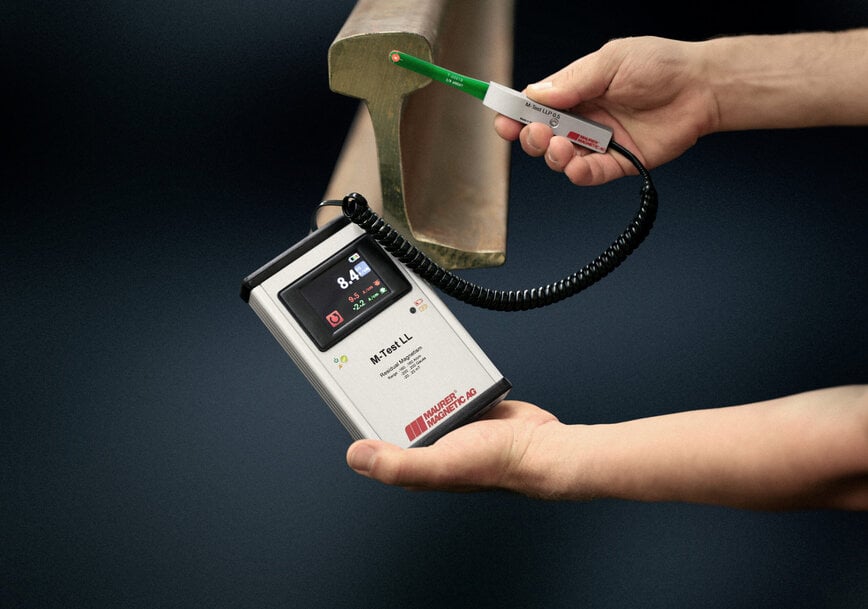
Rail procurement covers dimensional tolerances, surface condition and mechanical performance but rarely magnetism – a quality parameter that can determine whether a rail welds cleanly, train protection systems respond correctly and urban switches remain operational, writes Christian Spiess, Chief Operating Officer of Maurer Magnetic.
Manufacturers face intense pressure to deliver steel rail components that perform consistently and predictably once installed on the track, yet there’s one quality risk that’s rarely addressed – magnetism.
For most rail manufacturers, magnetisation sits entirely outside the quality conversation. It doesn’t appear in standard production specifications, isn’t visible to the eye and, because problems tend to surface downstream – during installation, commissioning or early operation, the connection back to the production environment is rarely made.
The result is a quality risk that persists largely by default, even though the issue is actually straightforward to measure and resolve.
How Rails Become Magnetised
Magnetisation is an often-unavoidable byproduct of steel rail manufacturing, introduced during the rolling, handling and transport of the components via two main sources: lifting magnets and magnetic particle inspection (MPI).
The lifting magnets widely used during handling can locally magnetise the rails, particularly at the points where the magnets are applied, while MPI, used selectively in rail and rail component quality control, uses magnetisation to check the rails for cracks. If the components aren’t properly demagnetised after, residual magnetism can remain.
Why Magnetism Matters
Alteration to the rails’ magnetic state often goes unnoticed during production, as it’s only when they reach the track that its impact begins to be seen.
The first of these downstream issues can raise its head during welding, as strong magnetism can deflect the welding beam, which prevents a proper join. In many cases, welding operators may not realise magnetism is the cause of their problem and simply apply more effort to attempt to complete the weld. This is particularly a concern for manual welding, as operators under high pressure may not report the problem.
Post-installation, magnetism can disrupt operations by interfering with train control systems, causing sensors and track magnets to fail to register correctly. In this scenario, components on the train or track may be affected, or the magnets replaced instead of resolving the real issue.
While these two problems are usually identified quickly, the third issue may only become apparent after the rails have spent some time in operation. This is because magnetised rails, especially in urban tram networks, can attract magnetic particles and small metal objects such as paperclips.
While this may not be a problem at first, over time they can build up, sticking to the rails and preventing proper movement. This is especially of concern in areas where the rails move, such as switches, and can lead to operational issues.
Driving Change
While the problems magnetism can cause are challenging, the solution is simple – demagnetisation. The issue here, though, is that the problem isn’t widely recognised, so there’s no guidance to follow or an industry standard for residual magnetism in finished rails or the track as a whole once the rails are installed.
To help establish standards, and reduce the issues that rail magnetism can cause, we need more operators to request that the rails they purchase are demagnetised.
In response, manufacturers should be looking to introduce a demagnetisation machine to their production line to ensure this is the case. This should be positioned at the latest possible stage of the production process to ensure that no other steps can re-magnetise the rails – for example, magnetic lifting equipment should not be used post-demagnetisation.
Demagnetisation Systems
A demagnetisation system is typically based on two modules – one for demagnetisation and the other for power. The demagnetisation module is most often configured as a tunnel coil, while the power module acts as a controlled current generator. The system is usually installed and calibrated according to specified parameters, which the machine regularly monitors to ensure these remain stable and consistent.
During demagnetisation, rails pass through the tunnel coil, which generates an alternating magnetic field. This gradually randomises and reorients the magnetic domains in the steel, effectively reducing the residual magnetism. As the rails move away from the coil, the strength of the alternating field progressively decreases until it vanishes, leaving the rails demagnetised.
It’s then recommended to measure the residual magnetism of the rails before delivery to the customer. This can be done using a handheld gaussmeter or an automatic sensor system integrated into the production line, which checks the rails immediately after demagnetisation.
Early Adopters
One example of procurement-led specification driving change comes from a major European rail operator that introduced a requirement for demagnetised rails as part of its supply chain standards, setting a defined limit on the maximum permitted level of residual magnetism in a finished rail.
For the supplier awarded the contract, this created an immediate practical challenge: they didn’t have demagnetisation equipment in-house. The solution was to rent a Maurer-Degaussing machine and use it to process the rails before delivery. The rails were brought within specification, the contract was fulfilled, and the operator received infrastructure that met its magnetic performance requirements from day one.
The Case for Acting Now
Manufacturers who introduce demagnetisation first stand to gain a tangible competitive advantage, as delivering demagnetised rails to a verified magnetic specification is a key differentiator. For a quality director looking to strengthen a supplier’s value proposition, or a sales team pitching to increasingly specification-conscious network operators, the ability to demonstrate controlled magnetic performance alongside established mechanical and dimensional checks is a meaningful addition to the offer.
The case is no less compelling from the operator side, and arguably more urgent. Specifying a residual magnetism limit on rail procurement is a relatively modest ask. It adds a measurable, verifiable parameter to a process that already involves extensive quality requirements. Set against the potential costs of magnetisation-related failures, such as welds that can’t be completed, train protection systems triggering unplanned emergency stops, or switches fouled by accumulated metallic debris, the upfront effort is small.
What the industry currently lacks isn’t the technology to solve the issue, but the habit of asking for it. Magnetic control is ready to take its place alongside the dimensional tolerances, surface condition checks and mechanical testing that already define steel rail quality. It requires no fundamental change to how rails are manufactured, only the recognition that the magnetic state of a finished component is as relevant to downstream performance as any other parameter.
For operators with the foresight to specify it, and manufacturers with the capability to meet it, that recognition is already translating into smoother installation and infrastructure that performs as intended from the moment it enters service.
Maurer Magnetic is a leader in the demagnetisation of railway components, and its range of solutions includes the industry-leading Maurer-Degaussing demagnetisation machine and M-Test LL magnetism measurer.
www.maurermagnetic.com
