
railway-international.com
18
'26
Written on Modified on
Low-Floor Trams with Integrated Collision Prevention
Škoda Group supplies bidirectional trams with active safety systems for Bergamo’s new T2 line, supporting urban and suburban operations under European standards.
www.skoda.cz
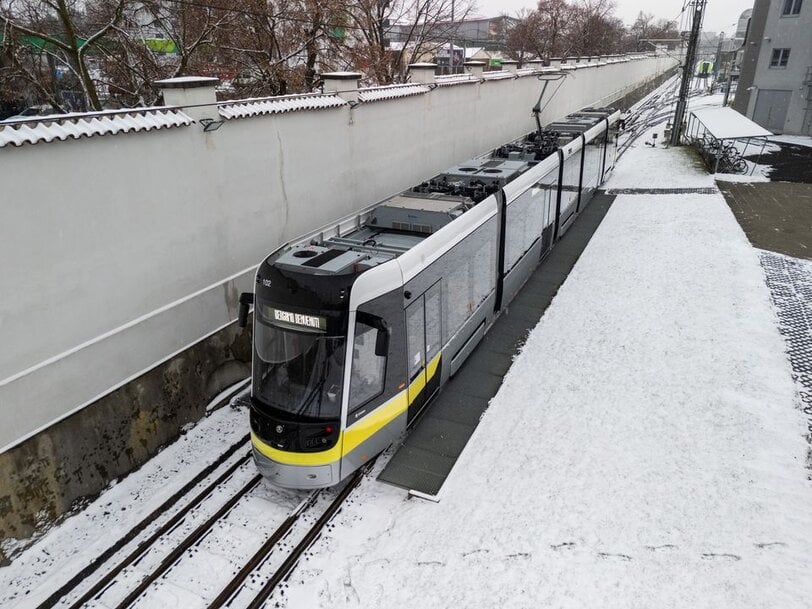
Škoda Group has presented a new generation five-section tram for Bergamo, Italy, combining a 100% low-floor configuration with an onboard anti-collision system designed for continuous operation. Ten vehicles will be delivered for the city’s new T2 line connecting Bergamo station to Villa d’Almé.
Application Context: Urban and Suburban Tram Operations
The vehicles are intended for mixed urban and suburban service, including tunnel sections and operation through Bergamo’s historic centre. Designed for a 1,435 mm standard gauge network and powered at 750 V DC, the trams address the technical requirements of a newly built corridor that combines city streets with segregated alignments.
With a maximum design speed of 70 km/h and bidirectional capability, the trams eliminate the need for turning loops at terminal stations. This configuration supports infrastructure flexibility and reduces civil engineering constraints in dense urban areas.
Vehicle Architecture and Passenger Capacity
The tram is based on the ForCity Classic platform and adapted for local operating conditions. Key technical parameters include:
Five car sections with three bogies, two of which are traction bogies
- Maximum vehicle length of 33,500 mm
- External width of 2,400 mm
- Roof height above platform edge of 3,600 mm
- Entrance edge height of 350 mm
- 100% low-floor passenger area
- Eight double doors, each 1,300 mm wide
At a reference density of six passengers per square metre, total capacity reaches 281 passengers. Two dedicated spaces are provided for persons with reduced mobility. Full low-floor access combined with wide doors is intended to reduce dwell times and improve accessibility compliance.
Active Safety and Digital Monitoring
A central technical feature is the integrated anti-collision system. The system continuously monitors the area in front of the vehicle and is designed to assist in preventing frontal impacts. This function complements the automatic train stop system and supports operation in pedestrian-dense environments.
The tram is also equipped with remote diagnostics, forming part of a digital maintenance approach. Continuous monitoring of electrical and traction components enables condition-based servicing, reducing unplanned downtime and supporting lifecycle cost control. Such features align with broader trends in digital supply chain integration for urban mobility fleets.
Environmental Control and Maintainability
Passenger comfort systems include full air-conditioning in both passenger saloon and driver’s cab, as well as LED lighting. From an engineering perspective, the design emphasises improved accessibility to technical components and durable structural construction to support long service intervals.
The 1,800 mm wheelbase and three-bogie arrangement are configured to balance curve negotiation performance with structural stability, particularly relevant for operation on mixed-profile routes.
Delivery and Market Position
All ten units are scheduled for completion within the year, with first deliveries planned from March. The Bergamo contract forms part of broader activities by Škoda Group in Italy, where ongoing projects exceed CZK 6 billion (approximately EUR 250 million). These include rolling stock for night trains in cooperation with Titagarh Firema and 112 trolleybuses for Genoa delivered with Solaris, with Škoda supplying electrical equipment and traction batteries.
In 2024, Škoda Group reported revenues of EUR 1.36 billion and EBITDA of EUR 62 million. The company employs approximately 10,000 people across production sites in the Czech Republic, Finland and Turkey and operates business units in several European countries.
For Bergamo’s T2 corridor, the combination of bidirectional design, full low-floor access, and integrated collision prevention provides a technically standardised solution tailored to local infrastructure constraints while meeting current European operational and safety requirements.
www.skodagroup.com
Active Safety and Digital Monitoring
A central technical feature is the integrated anti-collision system. The system continuously monitors the area in front of the vehicle and is designed to assist in preventing frontal impacts. This function complements the automatic train stop system and supports operation in pedestrian-dense environments.
The tram is also equipped with remote diagnostics, forming part of a digital maintenance approach. Continuous monitoring of electrical and traction components enables condition-based servicing, reducing unplanned downtime and supporting lifecycle cost control. Such features align with broader trends in digital supply chain integration for urban mobility fleets.
Environmental Control and Maintainability
Passenger comfort systems include full air-conditioning in both passenger saloon and driver’s cab, as well as LED lighting. From an engineering perspective, the design emphasises improved accessibility to technical components and durable structural construction to support long service intervals.
The 1,800 mm wheelbase and three-bogie arrangement are configured to balance curve negotiation performance with structural stability, particularly relevant for operation on mixed-profile routes.
Delivery and Market Position
All ten units are scheduled for completion within the year, with first deliveries planned from March. The Bergamo contract forms part of broader activities by Škoda Group in Italy, where ongoing projects exceed CZK 6 billion (approximately EUR 250 million). These include rolling stock for night trains in cooperation with Titagarh Firema and 112 trolleybuses for Genoa delivered with Solaris, with Škoda supplying electrical equipment and traction batteries.
In 2024, Škoda Group reported revenues of EUR 1.36 billion and EBITDA of EUR 62 million. The company employs approximately 10,000 people across production sites in the Czech Republic, Finland and Turkey and operates business units in several European countries.
For Bergamo’s T2 corridor, the combination of bidirectional design, full low-floor access, and integrated collision prevention provides a technically standardised solution tailored to local infrastructure constraints while meeting current European operational and safety requirements.
www.skodagroup.com
