
railway-international.com
25
'26
Written on Modified on
Hydrogen Fuel Cell Trains for Italian Narrow-Gauge Rail Networks
Stadler collaborates with Italian regional transport authorities to introduce hydrogen fuel cell rolling stock designed specifically for non-electrified narrow-gauge infrastructure.
stadlerrail.com
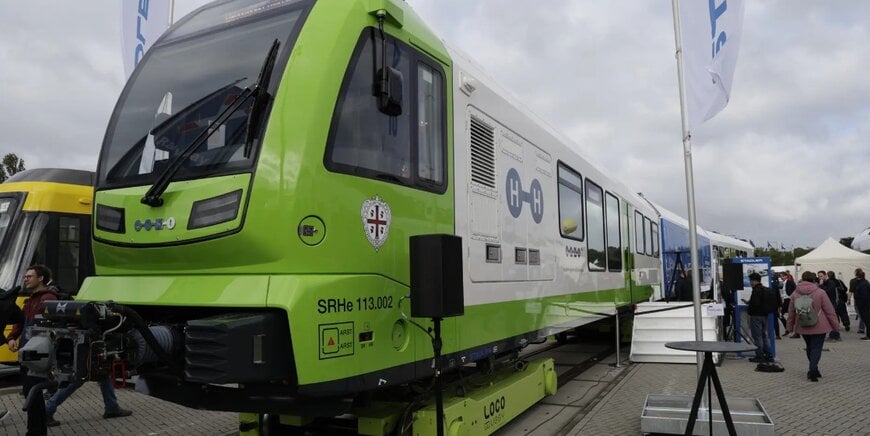
Swiss rolling stock manufacturer Stadler, in partnership with Italian transport authorities Azienda Regionale Sarda Trasporti, Ferrovie della Calabria, and Ferrovia Circumetnea, has introduced hydrogen-powered multiple units engineered for narrow-gauge regional networks. Operating across non-electrified passenger corridors in Sardinia, Calabria, and Sicily, these vehicles deliver zero-emission regional transit in demanding operational environments.
Technical Architecture and Fuel Cell Integration
The rolling stock addresses the operating parameters of regional lines characterised by tight curve radii, limited clearances, and demanding track profiles, including the steep gradients of the Etna Nature Park and mountain tunnels across Calabria. To meet these structural constraints, the train configuration is built on a shared modular platform utilizing lightweight mechanical bodies to keep axle loads within narrow-gauge track limits.
Traction power is provided by a hybrid fuel cell system situated within an intermediate power module. This unit houses hydrogen storage reservoirs and fuel cell stacks, which operate alongside onboard traction battery systems. The batteries act as energy buffers to handle acceleration peaks and absorb regenerative braking energy, while the fuel cell provides continuous baseline generation and battery replenishment during operation. Deploying ten of these hydrogen trainsets eliminates more than 2,100 tonnes of carbon dioxide emissions annually relative to equivalent diesel railcars.
Infrastructure and Fuel Supply Systems
Operational implementation encompasses rolling stock production alongside dedicated primary energy generation. Azienda Regionale Sarda Trasporti, Ferrovie della Calabria, and Ferrovia Circumetnea are constructing solar generation facilities to supply electrical power for on-site electrolysis. Utilizing dedicated photovoltaic power plants ensures that the hydrogen fuel cycle remains free of direct carbon emissions from production to trackside consumption.
Procurement Framework and Passenger Architecture
Manufacturing takes place at the Stadler manufacturing facility in Bussnang, Switzerland, covering an initial batch of 21 vehicles. Azienda Regionale Sarda Trasporti holds a framework contract for ten vehicles, while Ferrovie della Calabria has ordered nine units, and Ferrovia Circumetnea has contracted two units for operations around Mount Etna.
Passenger accommodation includes low-floor carriage entrances to eliminate platform step-up barriers for reduced-mobility travelers, broad panoramic window sections, and reduced cabin noise levels achieved by removing internal combustion diesel engines from the carbody.
Additional Context
This section details technical specifications and competitive benchmarking not included in the original product announcement.
Narrow-gauge hydrogen multiple units operate under track gauge parameters—predominantly 950 mm across Italian non-electrified local networks—that prohibit the direct transfer of standard-gauge (1,435 mm) fuel cell platforms such as the Alstom Coradia iLint or the Siemens Mireo Plus H. Standard-gauge platforms distribute hydrogen cylinders, fuel cells, and auxiliary cooling systems across extensive roof equipment spaces or within standard-profile carbodies. Narrower vehicle loading gauges restrict roof volume and maximum axle loads (typically limited to 12 to 14 tonnes per axle on regional narrow-gauge lines compared to 20 to 22.5 tonnes on European standard-gauge lines).
To overcome these structural limitations, Stadler employs a discrete intermediate power pack wagon between driving cars. This layout isolates fuel storage and electrochemical generation equipment into an independent carbody module, maintaining passenger compartment floor heights, balancing overall train axle weight distribution, and allowing shared components across varying gauge configurations.
Edited by Evgeny Churilov, Induportals Media - Adapted by AI.
www.stadlerrail.com
