
railway-international.com
12
'26
Written on Modified on
Digital Automatic Coupling Technology for Rail Freight Operations
ÖBB demonstrates the Digital Automatic Coupling (DAK) technology to automate wagon connections and enable data transmission across European rail freight networks.
www.oebb.at
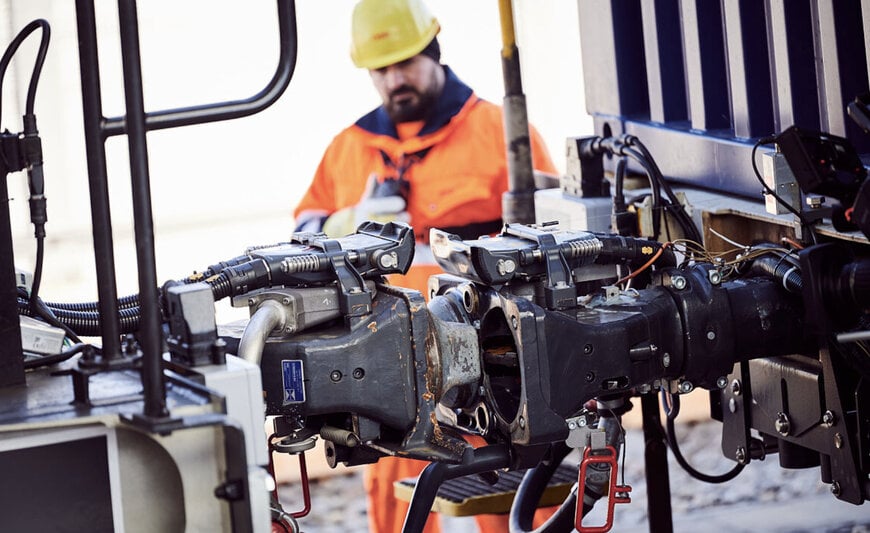
The Austrian Federal Railways (ÖBB) has demonstrated its Digital Automatic Coupling (DAK) technology under real operating conditions at the Floridsdorf freight station. The system replaces traditional manual screw mechanisms to automate the physical and electrical connection of rail freight wagons across the transport chain.
Challenges in European Rail Freight Operations
European rail freight transport has historically relied on manual screw couplings and side buffers, a labor-intensive mechanical method that limits the speed, safety, and efficiency of train assembly. Manual coupling requires personnel to work between wagons in hazardous environments and fundamentally restricts the ability to transmit electrical power or digital data across the train consist. To remain competitive and increase network capacity, the rail industry requires automated mechanical solutions that integrate continuous data networks, enabling heavier trains and faster processing times without requiring extensive physical infrastructure expansion.
Electro-Mechanical Architecture and Data Transmission
The DAK technology automates the physical coupling and uncoupling of freight wagons while simultaneously establishing a continuous transmission line for energy and data along the entire length of the train. This integrated network architecture enables numerous digital applications that were previously impossible with purely mechanical screw couplings. The system supports automated brake testing, digital recording of the wagon sequence, and continuous train integrity monitoring. By eliminating manual connection tasks, the technology accelerates operational processes, improves safety conditions for railyard personnel, and lays the groundwork for operating longer and heavier freight trains. ÖBB CEO Andreas Matthä states: "The DAK is the foundation for the digital freight train of the future and thus for a safer and more competitive rail freight transport in Europe."
Field Demonstration and Pioneer DAC Trains
As part of the Europe’s-Rail project FP5 TRANS4M-R, ÖBB is operating a specialized Austrian demonstrator train equipped with DAK technology on both freight wagons and locomotives. The system is undergoing field evaluations, including extreme winter testing, to assess technical reliability, maintenance requirements, and integration into existing operational workflows. Following the demonstration phase, ÖBB will deploy the technology in commercial freight transport through the Pioneer DAC Trains (PioDAC) project, supported by the Connecting Europe Facility (CEF). This phase aims to validate the system's technical maturity, economic viability, and adherence to harmonized European standards prior to a continent-wide migration plan.
Additional Context
This section details technical specifications and competitive benchmarking not included in the original product announcement
Within the global rail freight industry, the transition from traditional screw couplings to automated systems represents a critical structural upgrade. While North American heavy-haul networks rely predominantly on the mechanical Janney (AAR) knuckle coupler, and passenger transit systems utilize the Scharfenberg coupler, the European DAK initiative specifically targets the Type 4 Scharfenberg latch design adapted for freight. Unlike standard mechanical knuckle couplers that require separate manual connections for pneumatic brake lines, the DAK integrates the mechanical linkage, pneumatic air pipes, and an electrical and data bus into a single automated mating process. This unified connection provides the necessary power and Gigabit Ethernet bandwidth across individual freight cars required for future automated train operations (ATO) and real-time telematics, which legacy screw and buffer systems cannot physically support.
Edited by Maria Brueva, Induportals editor – adapted by AI.
www.oebb.at
