
railway-international.com
31
'26
Written on Modified on
Extended Range Validation for Battery-Electric Regional Rail Units
CAF has validated a standard production traction system to enable emission-free passenger transport on non-electrified regional railway networks without full route electrification.
www.caf.net
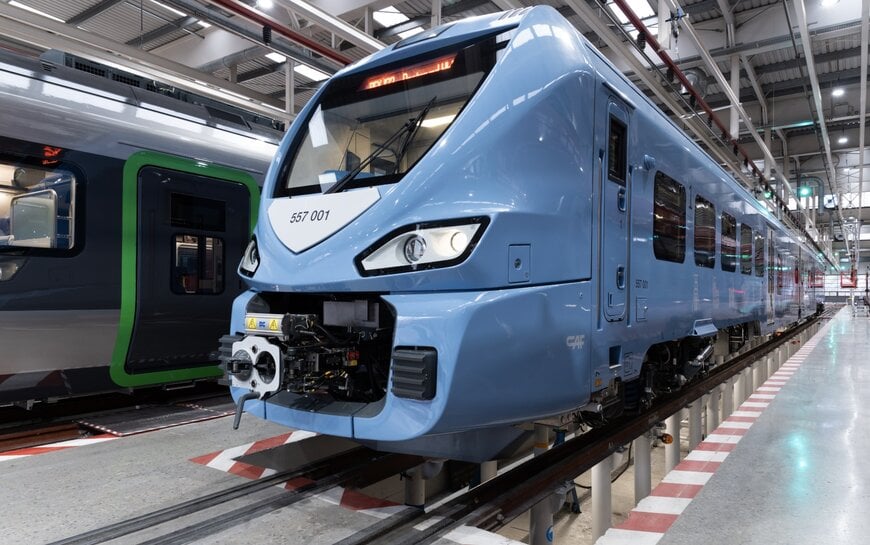
CAF is advancing its zero-emission rail portfolio with the successful 273-kilometer range test of a Class 557 battery-electric multiple unit (BEMU) at the Siemens Test and Validation Center in Wildenrath, Germany. This testing of standard Lithium Titanate Oxide (LTO) traction batteries provides critical performance data for deploying alternative propulsion systems across passenger rail operations.
System Integration and Energy Management
The testing protocol evaluated the interaction between the vehicle control framework, energy management systems, and the discharging behavior of the LTO batteries under extreme operational conditions. Engineers will cross-reference the empirical measurement data with the simulation models utilized during the Civity platform's development phase. Validating these energy discharge rates ensures the system can sustain prolonged operations exclusively on battery power, supporting the decarbonization of commuter transit segments.
Viability for Non-Electrified Routes
Battery-electric multiple units address the infrastructure limitations of regional rail transport by bridging gaps in the power grid. Operating the Class 557 for 273 kilometers on a single charge demonstrates the feasibility of servicing non-electrified rail sections without the capital expenditure required for overhead line installation. This approach offers a direct replacement for legacy diesel-powered passenger fleets. A standard-production short-type Class 557 unit engineered for the Verkehrsverbund Rhein-Ruhr (VRR) is scheduled for exhibition to industry specialists at InnoTrans 2026 in Berlin, taking place from September 22 to 25.
Additional Context
This section details technical specifications and competitive benchmarking not included in the original news release.
Benchmarking battery-electric multiple units involves comparing battery chemistry, operational range, and charging infrastructure requirements. The CAF Civity platform utilizes Lithium Titanate Oxide (LTO) batteries, which generally offer higher charge and discharge rates, greater thermal stability, and a longer cycle life compared to the Lithium Nickel Manganese Cobalt (NMC) batteries often used in competing platforms. In the competitive landscape, the Stadler FLIRT Akku achieved a recognized benchmark of 224 kilometers in battery-only mode during a 2021 test run, while the Siemens Mireo Plus B offers a standard operational range of up to 120 kilometers in typical regional service configurations. The 273-kilometer validation of the CAF Class 557 indicates an upward trend in energy density and efficiency within rail-specific energy storage systems, positioning it as a highly capable alternative for extended non-electrified routes.
Edited by Aishwarya Mambet, Induportals Editor, with AI assistance.
www.cafmobility.com
