
railway-international.com
03
'26
Written on Modified on
GYSEV InterCity FLIRT Train Procurement Enters Assembly Phase
GYSEV’s procurement of 11 Stadler FLIRT InterCity electric multiple units has progressed to final assembly in Poland, with testing scheduled for 2026.
stadlerrail.com
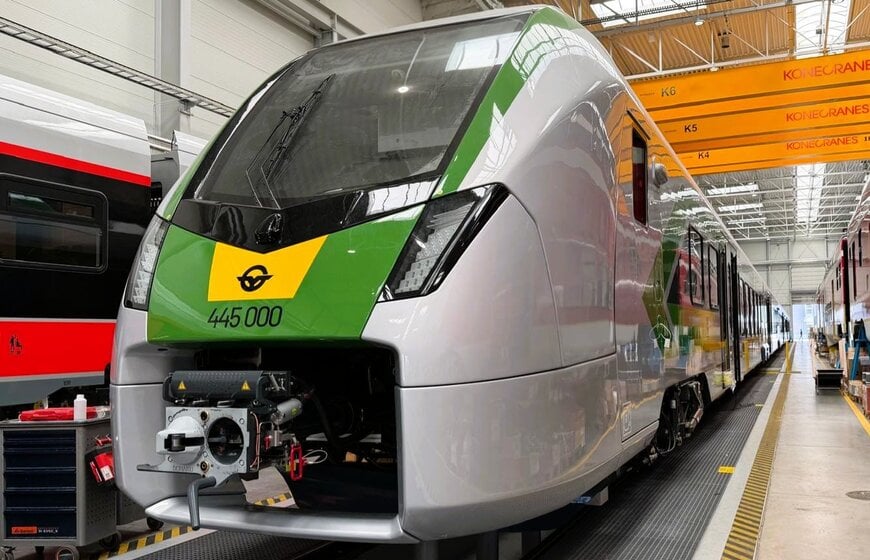
The procurement of 11 FLIRT InterCity electric multiple units (EMUs) by GYSEV has transitioned into its final assembly phase. The car bodies, manufactured at Stadler’s production facility in Szolnok, Hungary, have been transported to Siedlce, Poland, where the final mechanical and electrical assembly of the vehicles is being finalized. The trainsets are scheduled to be delivered to Hungary at the end of 2026 for type testing, with a phased rollout into active passenger service planned from 2027 through the summer of 2028 following regulatory certification.
Fleet Modernization and Manufacturing Logistics
The 11 new FLIRT-type EMUs represent the first InterCity rolling stock procurement in Hungary in 30 years, serving as a baseline initiative for the modernization of domestic rail infrastructure. Under the current production schedule, the painted car bodies are continuously manufactured at the Szolnok plant and shipped to the Siedlce factory for final integration.
The five-car, dual-system trainsets are engineered to operate at maximum service speeds of up to 160 km/h. Upon entering service, the fleet will support GYSEV’s InterCity services on the Sopron–Budapest and Szombathely–Budapest routes. Because the units utilize a dual-system electrical configuration, they are also capable of cross-border operations within the Austrian rail network.
Interior Configuration and Equipment Specs
The passenger cabin layout incorporates distinct technical and service features optimized for long-distance regional transport:
- Accommodation Classes: The interior features both first- and second-class seating arrangements within low-floor, air-conditioned passenger zones.
- Catering Facilities: An onboard dining area is integrated into the vehicle, outfitted with automated food and beverage vending machines.
- Modular Storage: The interior architecture is adjustable to handle seasonal demand shifts, accommodating up to 18 bicycles during summer operations.
- Passenger Connectivity: Every seating section includes integrated USB-C charging interfaces, local Wi-Fi infrastructure, and mounting holders for tablets and smartphones.
- Information Systems: A digital passenger information system provides real-time route tracking and telemetry updates throughout the trainset.
Multi-Country Validation and Testing Timeline
Testing protocols for the newly assembled rolling stock are scheduled to commence in August 2026. To optimize the certification timeline, the validation program will run in parallel across three separate national jurisdictions: Romania, the Czech Republic, and Hungary.
Following the conclusion of these initial runs, the first completed trainsets will arrive in Hungary by the end of 2026 to begin specialized domestic test runs. The full fleet of 11 units is projected to achieve complete operational status by the summer of 2028.
Additional Context
This section details technical specifications not included in the original news release.
The Stadler FLIRT (Fast Light Innovative Regional Train) platform relies on a modular articulated design utilizing Jacobs bogies between individual car sections. Unlike standard passenger coaches where each carbody sits on two independent bogies, a Jacobs bogie is positioned directly beneath the articulation joint linking two adjacent cars. This layout reduces the overall weight of the trainset, lowers track wear, and improves structural crashworthiness by preventing jackknifing during a derailment.
The low-floor architecture positions the entrance threshold flush with standard station platforms, easing passenger boarding and complying with technical specifications for interoperability regarding persons with reduced mobility (PRM). Power electronics, including traction inverters and auxiliary transformers, are mounted on the roof or in dedicated power packs behind the driver's cab to maximize floor space.
Operating across different national rail networks requires advanced multi-system electrical architecture and safety system integration. The dual-system configuration allows the FLIRT EMUs to switch seamlessly between Hungary’s standard overhead line electrification system (25 kV AC at 50 Hz) and Austria’s standard electrification grid (15 kV AC at 16.7 Hz). This transition is executed via high-voltage vacuum circuit breakers and multi-tap main traction transformers that step down the high voltage for the IGBT (Insulated-Gate Bipolar Transistor) pulse-width modulated rectifiers.
Concurrently, the onboard signaling system must integrate multiple legacy national Automatic Train Protection (ATP) systems alongside the European Train Control System (ETCS Level 2). This integration ensures full compatibility with the Hungarian EVM system, the Austrian PZB/Indusi systems, and standard ETCS radio block centers, enabling continuous speed supervision and automatic braking intervention across cross-border routes.
Edited by Romila DSilva, Induportals Editor, with AI assistance.
Testing protocols for the newly assembled rolling stock are scheduled to commence in August 2026. To optimize the certification timeline, the validation program will run in parallel across three separate national jurisdictions: Romania, the Czech Republic, and Hungary.
Following the conclusion of these initial runs, the first completed trainsets will arrive in Hungary by the end of 2026 to begin specialized domestic test runs. The full fleet of 11 units is projected to achieve complete operational status by the summer of 2028.
Additional Context
This section details technical specifications not included in the original news release.
The Stadler FLIRT (Fast Light Innovative Regional Train) platform relies on a modular articulated design utilizing Jacobs bogies between individual car sections. Unlike standard passenger coaches where each carbody sits on two independent bogies, a Jacobs bogie is positioned directly beneath the articulation joint linking two adjacent cars. This layout reduces the overall weight of the trainset, lowers track wear, and improves structural crashworthiness by preventing jackknifing during a derailment.
The low-floor architecture positions the entrance threshold flush with standard station platforms, easing passenger boarding and complying with technical specifications for interoperability regarding persons with reduced mobility (PRM). Power electronics, including traction inverters and auxiliary transformers, are mounted on the roof or in dedicated power packs behind the driver's cab to maximize floor space.
Operating across different national rail networks requires advanced multi-system electrical architecture and safety system integration. The dual-system configuration allows the FLIRT EMUs to switch seamlessly between Hungary’s standard overhead line electrification system (25 kV AC at 50 Hz) and Austria’s standard electrification grid (15 kV AC at 16.7 Hz). This transition is executed via high-voltage vacuum circuit breakers and multi-tap main traction transformers that step down the high voltage for the IGBT (Insulated-Gate Bipolar Transistor) pulse-width modulated rectifiers.
Concurrently, the onboard signaling system must integrate multiple legacy national Automatic Train Protection (ATP) systems alongside the European Train Control System (ETCS Level 2). This integration ensures full compatibility with the Hungarian EVM system, the Austrian PZB/Indusi systems, and standard ETCS radio block centers, enabling continuous speed supervision and automatic braking intervention across cross-border routes.
Edited by Romila DSilva, Induportals Editor, with AI assistance.
