
railway-international.com
02
'26
Written on Modified on
Drones Enhance Rail Monitoring and Incident Response
Infrabel expands drone deployment across Belgium to improve rail infrastructure monitoring, incident management, and operational efficiency, following a successful pilot in the Port of Antwerp.
www.infrabel.be
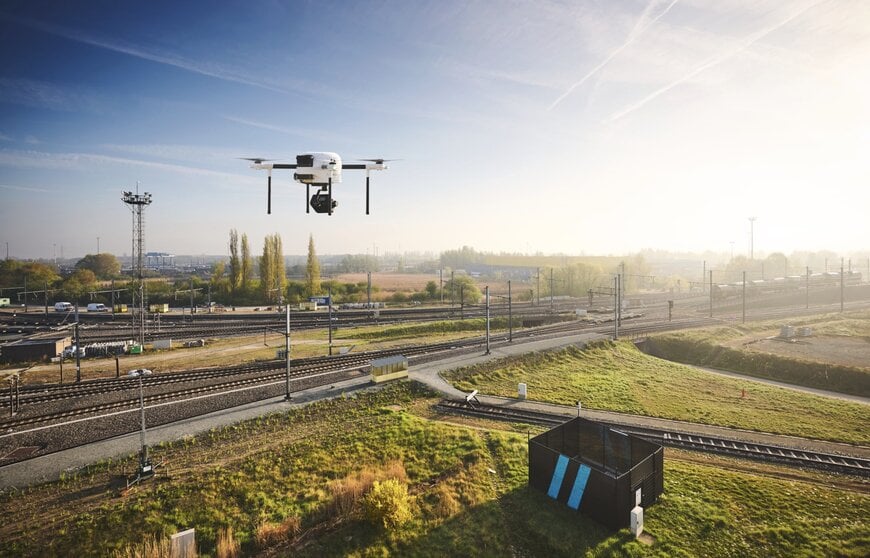
Infrabel is scaling the use of drones across its rail network after a pilot project demonstrated improved response times and operational visibility. The initiative supports infrastructure monitoring and incident management while highlighting the need for an enabling regulatory framework.
Pilot validation in complex rail environments
The initial deployment took place in collaboration with the Port of Antwerp under the BURDI initiative, aligned with the U-space framework. Operations focused on the Antwerp-North marshalling yard and the Oorderen rail network, both critical freight hubs with dense and complex infrastructure.
Drones were used to monitor rail traffic conditions and provide rapid situational awareness during incidents. Their ability to access difficult or hazardous areas enabled faster assessment of failures such as malfunctioning switches or signals.
Accelerated incident response and safety improvements
In incident scenarios, including derailments, drones provide aerial imagery to identify the location, assess infrastructure damage, and detect potential hazards such as hazardous material leaks. This data can be transmitted in real time to control centers and emergency services, supporting faster and more targeted intervention.
Compared to traditional response methods, drones can reach incident sites up to twice as fast, particularly in large or congested areas where ground access is limited. This contributes to reduced disruption and faster restoration of rail operations.
Complementary role to fixed systems and field teams
While fixed camera systems provide continuous monitoring at specific locations, drones offer flexible deployment and close-range inspection capabilities. They can capture high-resolution images from optimal angles, improving diagnostic accuracy.
Drones also support field teams by performing initial assessments, allowing personnel to focus on repair and recovery tasks. However, their use is constrained by operational factors such as weather conditions and flight range, meaning they complement rather than replace human intervention.
Centralized operations and network expansion
Following the pilot, drone operations have been extended to additional rail lines, including Waaslandhaven, Forest, and Châtelet. Deployment is managed centrally from a national traffic management center in Brussels, where trained operators coordinate drone missions.
The program includes the training of specialized drone pilots, including beyond visual line of sight (BVLOS) operations, enabling extended coverage of rail infrastructure.
Regulatory constraints and future deployment
A key challenge for wider deployment is the regulatory environment. A significant portion of the rail network lies within restricted airspace zones, limiting immediate drone usage. Infrabel is seeking regulatory adjustments, including special operational status, to enable more flexible deployment within these zones.
The organization plans to expand drone coverage to approximately 30 additional strategic rail lines by 2027–2028, supported by a fleet of mobile units. Planned applications include infrastructure inspection, construction monitoring, and coordination with emergency services, all within applicable privacy and safety regulations.
Edited by Romila DSilva, Induportals Editor, with AI assistance.
www.infrabel.be
