
railway-international.com
26
'26
Written on Modified on
Fiber-Optic Sensing Reduces Rail Monitoring Complexity
Distributed Acoustic Sensing enables continuous railway monitoring using existing fiber infrastructure, reducing maintenance burden and improving coverage for safety and security applications.
www.sensonic.com
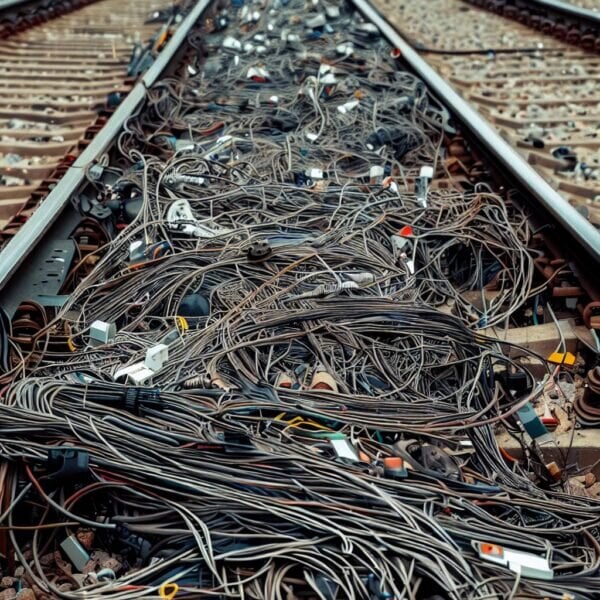
Railway operators are expanding monitoring systems to address increasing risks from extreme weather, infrastructure degradation, and security threats. Conventional approaches rely on large numbers of discrete sensors deployed along the track. While effective at specific points, this model introduces scaling challenges related to maintenance, coverage gaps, and infrastructure complexity.
Limitations of discrete sensor networks
Traditional railway monitoring systems are based on point sensors such as tiltmeters, cameras, and intrusion detectors. These devices provide localized measurements but require dense deployment to cover extended track sections.
This approach creates three structural challenges. First, each sensor introduces maintenance requirements, including battery replacement, calibration, and cleaning. Across multi-kilometre routes, this results in recurring track access operations and increased operational costs.
Second, the accumulation of hardware along the trackside increases exposure to environmental damage, vandalism, and accidental disruption during maintenance activities. A higher density of devices also complicates infrastructure management.
Third, point-based sensing inherently leaves gaps between monitored locations. Events such as landslides or cable theft may occur outside the detection range of individual sensors, requiring additional devices to improve coverage—further amplifying maintenance and cost issues.
Distributed Acoustic Sensing as a continuous monitoring approach
Distributed Acoustic Sensing (DAS) provides an alternative by transforming existing fiber optic cables into continuous sensing elements. Instead of deploying multiple field devices, a single interrogator unit connects to fiber infrastructure and analyzes backscattered light signals to detect vibrations along the entire cable length.
This enables continuous, real-time monitoring over long distances without installing additional trackside electronics. A single system can cover tens of kilometres, depending on deployment architecture.
Centralized sensing and reduced maintenance footprint
In a DAS-based system, sensing hardware is limited to a small number of interrogator units, typically installed in secure environments such as signaling or communications rooms. This removes the need for widespread field devices and significantly reduces maintenance exposure.
Fiber optic infrastructure itself requires minimal upkeep compared to distributed electronic sensors. As a result, the operational burden shifts from frequent field interventions to centralized system management.
Multi-application monitoring from a single data source
DAS enables multiple monitoring functions using a single sensing medium. By analyzing vibration signatures along the fiber, the system can detect and localize a range of events, including:
- Ground movement and rockfalls
- Trespass or intrusion along the track
- Cable interference or theft
- Electrical anomalies such as flashovers
Because the sensing is continuous, the system provides gapless coverage along the monitored route, eliminating blind spots inherent in point-based systems.
Cost efficiency and scalability
The ability to monitor long distances with minimal hardware improves cost efficiency, particularly when evaluated per kilometre of coverage. Scaling the system does not require proportional increases in field devices, enabling expansion without corresponding growth in maintenance requirements.
This model supports a shift from hardware-intensive deployments toward infrastructure-based sensing, where existing communication assets are leveraged for monitoring purposes.
Toward simplified and resilient rail infrastructure
The transition from discrete sensors to distributed fiber-optic sensing aligns with broader trends in railway digitalization. By reducing trackside hardware and centralizing intelligence, operators can improve system resilience, simplify maintenance workflows, and enhance situational awareness.
A continuous sensing approach supports more comprehensive monitoring while avoiding the long-term operational burden associated with large-scale sensor deployments.
Edited with AI assistance.
Edited with AI assistance.
