
railway-international.com
19
'26
Written on Modified on
Remote train operation tested on ICE 4 platform
Rheinmetall subsidiary MIRA joins Siemens Mobility-led RemODtrAIn project to validate AI-based obstacle detection and 5G-enabled remote train control for highly automated rail operations.
www.rheinmetall.com
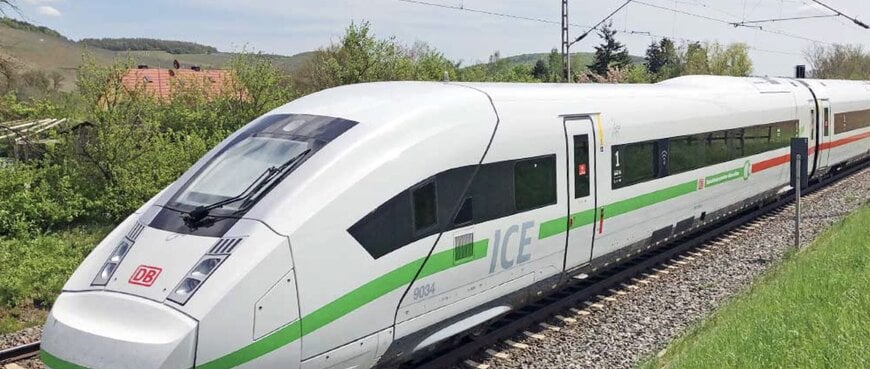
Within the European research project RemODtrAIn, Rheinmetall, through its subsidiary MIRA, is contributing to the development and validation of remote train operation (RTO) and AI-supported obstacle detection on mainline rolling stock, using an ICE 4 as the test vehicle.
Project scope and technical objective
RemODtrAIn (“Remote operated train with AI-based Obstacle Detection”) is led by Siemens Mobility and brings together industry partners, railway operators and research institutions. The core objective is to equip an ICE 4 train with a secure remote control system that allows operation from a control station located at a Deutsche Bahn maintenance depot near Cologne.
The system architecture is based on a 5G communication solution designed for high availability and secure data transmission under varying operational conditions. Alongside remote driving functions, the project evaluates modular AI-based obstacle detection in real traffic environments, including trials on the Berlin S-Bahn network.
MIRA’s contribution to remote train operation
MIRA is responsible for developing a robust, certifiable RTO solution that can be integrated into new rolling stock and retrofitted into existing fleets. The approach targets cost-effective deployment at scale and focuses on operational phases such as delivery, dispatching and stabling, where trains currently require on-board drivers despite low-speed and confined movements.
The solution consists of three core elements: a compact operator control unit for the remote driver, a teleoperation kit installed on the vehicle, and a cloud-based fleet management layer that supports the development of an RTO control centre. By standardising operator interfaces and control logic, the system is intended to allow a single operator to manage different train types without vehicle-specific retraining.
Safety, communication and certification framework
From a technical perspective, the MIRA system integrates a safety-designed vision system targeting ASIL-D requirements, a high-availability communications layer, and certified vehicle interfaces developed in cooperation with Cattron. The overall RTO package is designed to comply with relevant railway standards, ensuring that specifications defined in RemODtrAIn can be transferred into operational rail environments after the research phase.
AI-based obstacle detection is a key validation focus, aiming to demonstrate reliable perception performance under real-world conditions and to support safe remote operation beyond controlled depot scenarios.
Operational and system-level relevance
By enabling remote control of trains, RemODtrAIn addresses structural challenges in railway operations, including driver availability and resource utilisation. Remote operation allows one operator to control multiple vehicles sequentially or switch flexibly between train types, improving productivity and operational resilience.
The project is funded by the European Union and Germany’s “Digital – Sustainable – System-compatible” mobility programme, administered by the Federal Ministry for Economic Affairs and Energy (BMWE), with total funding of around €17 million. Beyond its technical outcomes, RemODtrAIn contributes to the digitalisation and sustainable modernisation of rail transport in Germany and Europe, particularly in non-revenue and low-speed operational domains.
www.rheinmetall.com
