
railway-international.com
14
'26
Written on Modified on
Engineering Reliability in Heavy-Haul Rail Operations
COMET explains how component quality, fatigue life, and proactive maintenance reduce failures and lower lifecycle cost per mile.
www.cometind.com
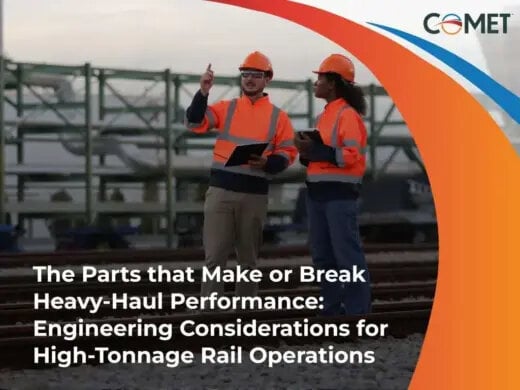
Heavy-haul rail operations impose significantly higher mechanical and thermal loads than standard freight service, making component engineering, fatigue performance, and proactive maintenance decisive factors in reliability and cost per mile.
Heavy-haul as a distinct operating environment
Heavy-haul railways transport high-density commodities such as coal, iron ore, and bulk industrial materials under axle loads that exceed those of conventional freight networks. These operating conditions generate elevated vertical, lateral, and longitudinal forces that accelerate fatigue damage and thermal stress across rolling stock components.
Unlike standard freight operations, reliability margins in heavy-haul service are narrow. A single component failure on a long, fully loaded train can disrupt network capacity, extend dwell times, and introduce safety risks. As a result, component selection and engineering standards have a direct impact on system velocity, asset utilization, and operational risk.
High-stress components in the truck assembly
The railcar truck assembly experiences the highest cumulative loading in heavy-haul service. Increased tonnage amplifies stress concentrations and exposes material limitations earlier in the component lifecycle.
Side frames and bolsters carry primary load transfer between the car body and wheelsets. Under heavy-haul conditions, these castings are subject to sustained bending and torsional stresses, increasing susceptibility to fatigue cracking if material quality or design margins are insufficient.
Bearings operate at elevated temperatures due to higher frictional loads. Prolonged thermal exposure accelerates lubricant degradation and increases the likelihood of surface spalling and seizure if bearing design or maintenance intervals are inadequate.
Wheels and wheelsets are exposed to higher rolling resistance and repeated thermal cycling, which can promote shelling, tread damage, and accelerated wear, particularly on routes with high curvature or variable track quality.
Engineering for fatigue resistance and standards compliance
To withstand heavy-haul loading, components must be specified beyond baseline freight requirements. This typically involves adherence to the highest applicable standards issued by the Association of American Railroads, particularly for fatigue life and material performance.
Advanced metallurgy plays a central role. High-strength steels and engineered alloys with controlled microstructures improve resistance to crack initiation and propagation under cyclic loading.
Fatigue performance must be validated through accelerated testing that reflects dynamic impacts and track irregularities encountered in service. Component selection based solely on static strength is insufficient for heavy-haul duty.
Reconditioned components are often essential for maintaining fleet availability, but only when restored to certified specifications. AAR-compliant reconditioning processes, including controlled heat treatment and dimensional verification, are required to ensure reconditioned parts can sustain heavy-haul service loads.

Cascading effects of component failure
Failures in heavy-haul truck assemblies are rarely isolated. Degradation in one component alters load distribution and accelerates wear in adjacent parts.
Distortion in side frames can misalign bolster seating, introducing uneven load paths. Bearing degradation transfers thermal and mechanical stress to axles and wheels. Spring failures can destabilize the truck, increasing hunting behavior and wheel-rail impact forces.
These interactions shorten overall assembly life and increase the probability of systemic failure. Preventing such cascades depends on consistent component quality across the entire truck assembly rather than isolated upgrades.
Inspection, monitoring, and maintenance strategy
Reactive maintenance approaches are poorly suited to heavy-haul operations. Effective asset management relies on early defect detection and condition-based decision-making.
Non-destructive testing methods such as ultrasonic and magnetic particle inspection are required at higher frequency for critical load-bearing components to identify sub-surface defects before crack propagation.
Wayside monitoring systems, including bearing temperature detectors, wheel impact load detectors, and truck hunting sensors, provide continuous operational data. When integrated into maintenance planning, these systems enable early intervention and reduce the likelihood of in-service failures.
Maintenance intervals in heavy-haul fleets are most effective when tied to cumulative tonnage rather than calendar time, aligning inspection and overhaul cycles with actual fatigue accumulation.
Lifecycle cost implications
For heavy-haul operators, engineering decisions translate directly into economic outcomes. Higher initial component quality and rigorous maintenance regimes reduce unplanned outages, extend service intervals, and improve predictability.
Lower lifecycle cost per mile is primarily achieved by extending component fatigue life and minimizing secondary damage caused by cascading failures. Improved availability and reduced emergency repairs also support more stable operating schedules and procurement planning.
Operational perspective
Heavy-haul performance depends on fleets engineered specifically for high-load environments. Components designed, tested, and maintained for these conditions contribute to safer operations, higher network velocity, and improved long-term cost control. In this context, component reliability is not a supporting factor but a primary determinant of heavy-haul system performance.
