
railway-international.com
03
'26
Written on Modified on
Railway Infrastructure Monitoring via Short-Range SAR
Symeo advances radar sensing for high-resolution infrastructure surveying and hazard detection.
www.symeo.com
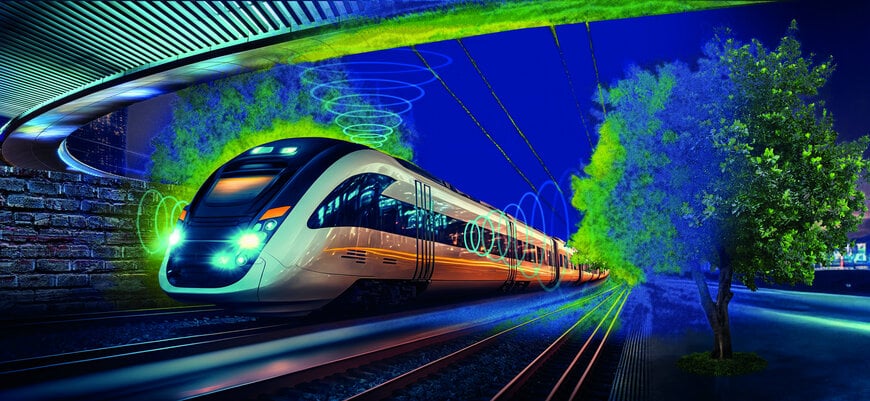
Synthetic Aperture Radar (SAR) technology, traditionally utilized in satellite and military applications, is being adapted for short-range railway monitoring. By mounting radar sensors on locomotives or trams, operators can generate high-resolution digital twins of trackside infrastructure. This data allows AI-driven pattern recognition systems to detect structural changes—such as slope movements or track instabilities—in real-time. Unlike optical systems, SAR provides high-precision imaging unaffected by environmental conditions like fog, dust, or low light, while ensuring privacy compliance by avoiding the capture of sensitive personal data.
Technical Principles of Short-Range SAR
The SAR methodology overcomes the physical limitations of compact antennas by creating a "synthetic aperture." As a vehicle travels, the sensor’s motion is combined with advanced signal processing to virtually emulate a larger antenna, achieving an angular resolution that would otherwise be impractical for mobile industrial hardware.
Operational Configurations:
- Side-looking SAR: Scans trackside infrastructure to monitor landslides or track bed stability.
- Forward-looking SAR: Facilitates obstacle detection and route surveying, providing detailed environmental data without the privacy issues inherent in camera-based systems.
Digital Twin and Data Integration
The continuous deployment of SAR-equipped vehicles allows for the ongoing synchronization of a digital twin of the entire railway network. Historical radar data provides a forensic audit trail for infrastructure-related incidents, such as ground instability. Looking ahead, the objective is to implement a cross-operator data network where every radar-equipped vehicle contributes to a unified, continuously updated digital representation of the rail infrastructure.
Scalability and AI-Driven Hazard Prevention
The effectiveness of this technology relies on a "data foundation" approach: the larger the dataset, the more accurately AI pattern recognition can identify latent hazards before they impact operations. By leveraging powerful onboard processing (NVIDIA GPUs) and data reduction techniques for 5G transmission, railway operators can share validated AI recognition patterns internationally. This fosters a collaborative safety ecosystem where infrastructure resilience is continuously enhanced through shared learning from operational events worldwide.
Edited by Lekshman Ramdas, Induportals editor – adapted by AI.
www.symeo.com
The continuous deployment of SAR-equipped vehicles allows for the ongoing synchronization of a digital twin of the entire railway network. Historical radar data provides a forensic audit trail for infrastructure-related incidents, such as ground instability. Looking ahead, the objective is to implement a cross-operator data network where every radar-equipped vehicle contributes to a unified, continuously updated digital representation of the rail infrastructure.
Scalability and AI-Driven Hazard Prevention
The effectiveness of this technology relies on a "data foundation" approach: the larger the dataset, the more accurately AI pattern recognition can identify latent hazards before they impact operations. By leveraging powerful onboard processing (NVIDIA GPUs) and data reduction techniques for 5G transmission, railway operators can share validated AI recognition patterns internationally. This fosters a collaborative safety ecosystem where infrastructure resilience is continuously enhanced through shared learning from operational events worldwide.
Edited by Lekshman Ramdas, Induportals editor – adapted by AI.
www.symeo.com
