
railway-international.com
01
'26
Written on Modified on
Adaptive Edge Computing Architecture for In-Vehicle Automation and Mobile Analytics
A certified SINTRONES processing platform integrates an internal neural processing unit to manage autonomous workloads across mass transit and industrial machinery environments.
www.sintrones.com
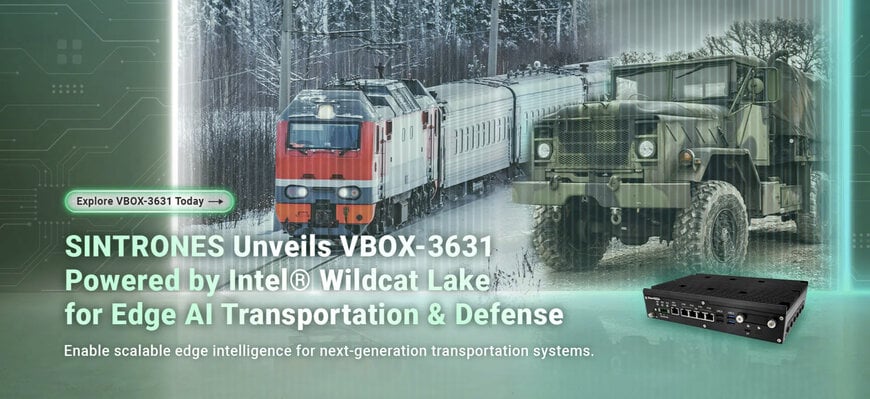
The release of the VBOX-3631 series by SINTRONES Technology Corporation establishes a rugged computing architecture designed for real-time video analytics and automated fleet tracking. This system introduces hardware compliance with rolling stock and automotive manufacturing certifications, delivering dedicated processing pipelines for deep learning applications directly at the vehicle physical point of deployment.
Industrial edge computing platforms operating within transit networks encounter highly unstable operating environments. Heavy mining equipment, commercial logistics fleets, and rolling rail transit subject electronic assemblies to continuous, low-frequency structural vibration and sudden kinetic impacts. Standard commercial computational infrastructure lacks the structural reinforcements needed to prevent component detachment or stress fractures along printed circuit board solder tracks under these intense mechanical forces.
To isolate internal components from these destructive mechanical strains, the computer utilizes a fanless, specialized chassis equipped with M12 threaded circular locking connectors. These heavy-duty industrial interfaces secure electrical contacts against prolonged vibration, ensuring reliable data transfer where standard interfaces fail. The platform achieves broad environmental tolerance by accommodating wide DC input variations ranging from 9 V to 60 V. This specialized regulatory circuitry permits direct integration into standard 12 V passenger vehicles, 24 V heavy machinery, and emerging 48 V locomotive electrical systems without secondary external power transformation hardware.
The computing core relies on Intel Core Series 3 processors, built on the Wildcat Lake microarchitecture, which feature up to 4.8 GHz max turbo frequencies alongside an integrated neural processing unit (NPU). This hardware topology allocates specialized machine learning processes away from traditional central execution lines:
- Neural Processing Optimization: The dedicated onboard NPU supplies up to 17 TOPS (trillion operations per second) of low-latency artificial intelligence inference performance, automating spatial object classification and sensor fusion data recording directly at the vehicle source.
- Dynamic Thermal Balancing: An adaptive power control system monitors instantaneous resource demands; the processor scales into low-power states during idle operations, reducing passive thermal generation within the fanless housing during high-temperature exposure (-40 to 70 degrees Celsius).
- Multi-Sensor Data Collection: Network capture pipelines process information simultaneously through a combination of one 2.5 GbE port, four GbE ports, and dual isolated Controller Area Network Flexible Data-Rate (CAN FD) channels, maintaining real-time telemetry syncing across transport networks.
This multi-interface layout accommodates localized productivity configurations via triple independent video feeds (HDMI, DVI-D, and USB Type-C) delivering up to 4K resolutions. Expansion paths utilize a modular, single-cover housing that houses a hot-swappable CMOS cell tray alongside three M.2 and one Mini PCIe slot, accommodating parallel NVMe solid-state storage arrays and dual 5G cellular communication cards.
Additional Context
This section details technical specifications and competitive benchmarking not included in the original product announcement.
Ruggedized transportation computers must strictly adhere to regulatory validation regimes, specifically the E-Mark standard for European automotive safety and the EN 50155 standard governing electronic hardware deployed on railway rolling stock. Primary global alternatives in this product category include the Neousys Nuvo-9000VTC series and the OnLogic Karbon 800 series.
While Neousys focuses heavily on high-wattage desktop-class processors coupled with discrete graphics processing cards, their systems demand substantially higher power profiles and bulkier enclosures, which limits installation flexibility in space-constrained rail control cabinets. Conversely, the OnLogic Karbon series offers similar modularity using proprietary expansion bays, but it is optimized primarily for standard factory automation networks.
The SINTRONES VBOX-3631 differentiates itself from these options by natively introducing the specialized Wildcat Lake hybrid processing platform. This microarchitecture achieves a critical balance for transport operations: it delivers up to 17 TOPS of localized AI computation via the integrated low-power NPU, matching the machine learning throughput of discrete accelerators while remaining within a passive, low-wattage thermal envelope.
Edited by Natania Lyngdoh, Induportals Editor, with AI assistance.
www.sintrones.com
Additional Context
This section details technical specifications and competitive benchmarking not included in the original product announcement.
Ruggedized transportation computers must strictly adhere to regulatory validation regimes, specifically the E-Mark standard for European automotive safety and the EN 50155 standard governing electronic hardware deployed on railway rolling stock. Primary global alternatives in this product category include the Neousys Nuvo-9000VTC series and the OnLogic Karbon 800 series.
While Neousys focuses heavily on high-wattage desktop-class processors coupled with discrete graphics processing cards, their systems demand substantially higher power profiles and bulkier enclosures, which limits installation flexibility in space-constrained rail control cabinets. Conversely, the OnLogic Karbon series offers similar modularity using proprietary expansion bays, but it is optimized primarily for standard factory automation networks.
The SINTRONES VBOX-3631 differentiates itself from these options by natively introducing the specialized Wildcat Lake hybrid processing platform. This microarchitecture achieves a critical balance for transport operations: it delivers up to 17 TOPS of localized AI computation via the integrated low-power NPU, matching the machine learning throughput of discrete accelerators while remaining within a passive, low-wattage thermal envelope.
Edited by Natania Lyngdoh, Induportals Editor, with AI assistance.
www.sintrones.com
