
railway-international.com
15
'26
Written on Modified on
Why Rail Substructure Maintenance Needs to Change
TrackTex, InterAx Geogrid and GeoSpike are giving railroads a better, and more cost-effective, alternative to repeat maintenance, explains Donald Herbert, Rail Market Manager at Tensar.
www.tensarcorp.com
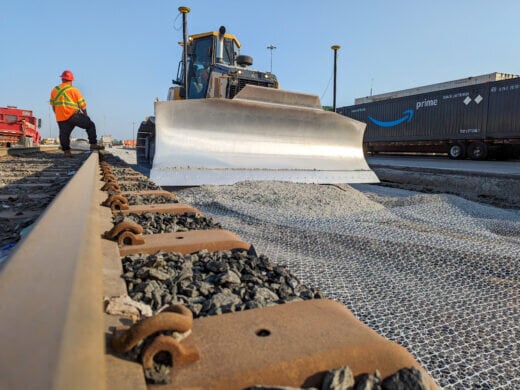
Ballast settlement and movement is one of the rail industry’s most persistent problems, driven by water, fine-grained soil and the relentless pressure of axle loads on trackbeds that can be more than 50 years old.
These come together to create a recipe for trouble in the form of mud pumping. This is where fine silts and clays become slurry that’s drawn up into the ballast, fouling it and lubricating the rocks, which reduces load bearing properties leading to trackbed destabilisation and potential loss of track alignment.
The default response has been the same: dump more rock, resurface and repeat, but this only addresses the symptom, not the cause.
The good news is that the latest geosynthetic and ground improvement solutions make it possible to tackle these problems at source. Each has its own benefits, but the real power comes from knowing when to combine them. Site conditions, problem severity and whether track can come out of service all determine which approach – or combination thereof – makes most sense. Here are the options.
The Anti-Mud Pumping Solution – TrackTex
TrackTex is a patented five-layer geocomposite developed by Network Rail and GEOFabrics in the UK, and available in the US exclusively through Tensar. It’s proven to be the most cost-effective way of preventing or correcting mud pumping issues; shown to outperform standard geotextiles thanks to the unique microporous membrane at its core, which unlike other solutions, won’t blind off or clog.
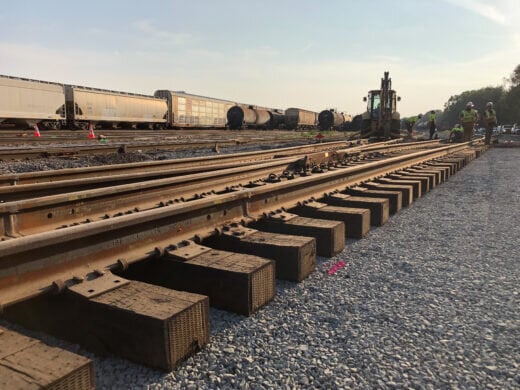
It works in a similar way to Gore-Tex coats, acting as a one-way valve. The membrane allows water to bleed upward through microporous holes under train load, but the holes are small enough to block even the finest silts down to 0.005 microns. Once the train passes, the holes then close. In the case of rain, TrackTex then acts like an umbrella, preventing re-saturation from above.
Many railroad companies have seen the benefits of TrackTex firsthand. Take Norfolk Southern. Sections of its track in Christiansburg, Virginia, had begun failing again within two years of being undercut and renewed with clean ballast, and so they looked for a longer-term solution.
Installation of TrackTex was simple. The track was lifted and the material slid into position with no requirement for special equipment. When tested two and a half years later, the ballast had remained clean and structurally sound through 60mgt of traffic with a timetable speed of 40mph.
Stabilising the Ballast – Tensar InterAx Geogrid
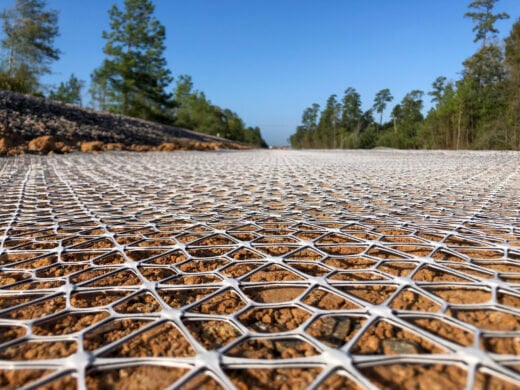
TrackTex addresses the source of fouling from below, but doesn’t stabilise the ballast itself. This is where the Tensar InterAx Geogrid comes into play. Under load, ballast can fail in a ‘J-curve’ pattern, where rocks are pushed outward and downward. A geogrid can be used to confine the rock, reducing lateral movement and ballast breakdown, and therefore stabilising the trackbed.
This solution is well suited for new construction or planned maintenance projects where track is being removed, and while it can be used alone, when combined with TrackTex different trackbed failure mechanisms can be targeted simultaneously.
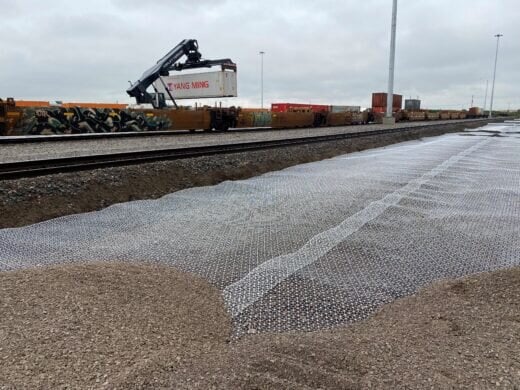
The Chicago Transit Authority (CTA) did just that when reconstructing transit lines on a section of its Congress Line. Some areas had an initial bearing value (IBV) of less than 4%, which meant that 12” of undercut and refilling of aggregate would be needed before the subballast and ballast could be placed.
Time consuming and costly, Tensar engineers instead recommended 8” of subballast and 12” of ballast on top of a Tensar InterAx GeoGrid, plus a layer of TrackTex to preserve the ballast. This eliminated the undercut entirely, saving US$500,000 and replacing 1,200 truckloads of material with just four truckloads of geosynthetics, while also ensuring long-term trackbed protection.
Maintaining Without Stopping: GeoSpike Railway Subgrade System
The third tool at railroads’ disposal is Geopier’s GeoSpike system, one of the fastest growing solutions in the market. This solves a different but just as operationally-critical problem: how to fix failing track without taking it out of service.
GeoSpike is a ground improvement solution driven through the crib without removing rail, cutting signals or re-welding. The spikes act like mini-piles below the rail, stopping track settlement and movement, which in turn reduces mud pumping.
They can be used for a wide variety of environments, including but not limited to yards, adjacent multi-track environments, or where signalling constraints make conventional intervention impossible. Simple to install, the spikes only require an excavator and a crew of three, and with no specialist contractors needed the work can be undertaken by in-house maintenance teams.
What’s most unique about this solution is that operations can continue during installation, albeit at slow order speeds. This is a game changer, as track outages for undercutting or rolled product installation are expensive not just in labour and re-welding costs, but in lost operating time. With a single delayed freight train costing US$1-2 million in lost revenue, reducing the track time needed to fix a problem can have a huge impact on income.
The Right Solution for the Right Problem
Tensar’s portfolio of products can be mixed and matched to fit any scenario. All three products have been deployed with a high degree of success on their own, and the goal is always to match the solution to the site conditions, not to apply all three by default.
In practice, that means Geogrid and/or TrackTex for both new construction and planned maintenance projects, and GeoSpike where track simply cannot come out of service. Where conditions are particularly severe – repeat settlement, soft fine-grained soils, chronic fouling etc – products deployed in combination can deliver results that neither achieves alone.
For example, when combined, testing indicates that Geogrid and TrackTex can extend maintenance cycles by a factor of up to 25. For a railroad resurfacing a trouble spot two or three times a year, that could translate to years between interventions.
The true cost of a maintenance problem is rarely just the materials; it’s also track time, equipment, signalling reconnection and operational disruption. Measured against that, a geosynthetic solution is a modest investment.
There are also tangible environmental benefits from implementing any of these solutions, as there are fewer excavations, less quarried and transported stone and significantly reduced maintenance which all contribute to a smaller carbon footprint over the life of the asset.
Addressing trackbed problems at source rather than managing them on repeat represents a fundamental shift for the industry, and the results speak for themselves. To find out which solution is right for your network, contact Tensar’s rail experts.
www.tensarcorp.com
