
railway-international.com
09
'26
Written on Modified on
Digital Automatic Coupling Advances Rail Freight Automation
ÖBB Rail Cargo Group tests a new coupling system enabling mechanical, pneumatic, and digital connections between freight wagons to support automation in European rail logistics.
www.oebb.at
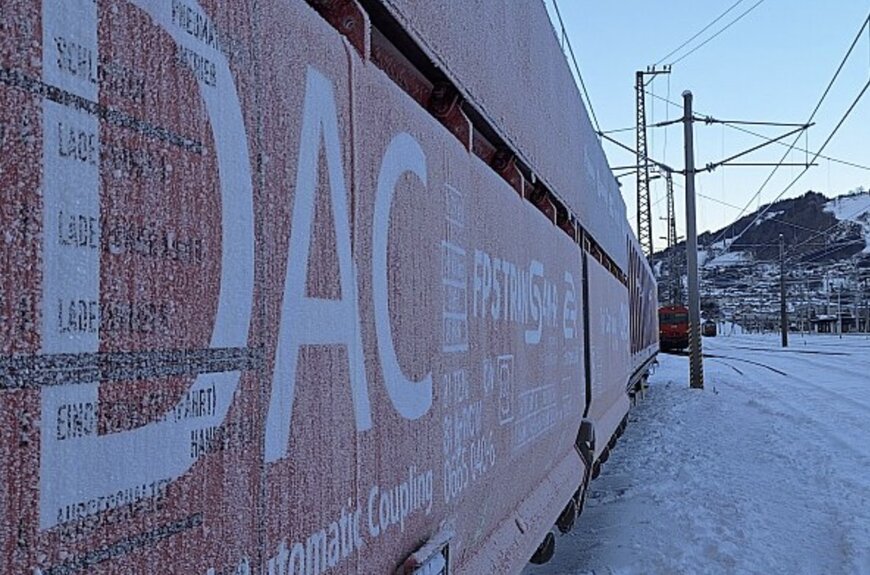
Rail freight operations in Europe still rely on manual screw couplings introduced more than a century ago, requiring physically demanding procedures and limiting automation. In this context, ÖBB Rail Cargo Group tested the Digital Automatic Coupling (DAC) using a demonstration train to evaluate the system under real operating conditions.
Replacing manual screw couplings with automated connections
The Digital Automatic Coupling (DAC) is designed to replace the traditional manual screw coupling used across European freight trains. The conventional system requires rail workers to manually connect wagons, attach brake air lines, and verify mechanical coupling between vehicles.
DAC automates this process by connecting wagons mechanically while simultaneously establishing pneumatic, electrical, and digital links across the train. In addition to compressed air lines for braking systems, the coupling provides continuous power and data transmission between wagons.
This integrated connection enables new digital functions within rail operations, supporting the broader digital rail freight transformation underway in Europe.
Demonstration train evaluates interoperability and system integration
To validate the technology under real conditions, ÖBB Rail Cargo Group (RCG) deployed a DAC demonstration train equipped with coupling systems from multiple manufacturers. The project aims to test whether mechanical, electrical, and data systems can operate reliably across mixed equipment.
Testing focuses on ensuring that wagons equipped with DAC can couple automatically while maintaining stable data and power connections throughout the train. These capabilities are required to support digital applications such as automated brake testing, continuous train monitoring, and future automation functions.
Achieving interoperability between equipment from different manufacturers is a key step toward large-scale implementation across the European freight network.
Winter testing examines reliability in extreme weather
To evaluate system performance under harsh environmental conditions, the demonstration train underwent a three-week winter test campaign in Austria.
Tests were conducted at Schwarzach-St. Veit station in the Salzburg Pongau region, where temperatures reached –15°C and conditions included freezing rain and snowfall. Engineers repeatedly tested mechanical coupling procedures, push-button electrical uncoupling, and the reliability of pneumatic and digital connections.
The testing program examined how cold temperatures and ice affect components such as lubricants, seals, and electrical contacts, all of which are critical to reliable coupling and brake system operation.
To simulate real freight operations, the train was also parked for ten days in Böckstein. This allowed engineers to study the effects of extended idle periods while intentionally exposing components to snow and ice accumulation in order to identify potential weaknesses.
Test results support further development toward deployment
The first test phase aimed to identify possible technical issues early in development. Preliminary results indicated that the tested systems maintained reliable functionality even under demanding winter conditions.
These tests provided operational data for further refinement of the coupling technology and confirmed progress toward a Europe-wide standardized Digital Automatic Coupling system.
DAC development is particularly relevant for single-wagon freight networks, where frequent coupling and uncoupling operations make automation especially beneficial.
Key technology for digital rail freight
The Digital Automatic Coupling project is one of the largest technological modernization efforts in European rail freight. By enabling automated wagon coupling and continuous data connectivity across trains, the technology forms a foundation for rail automation and digital freight operations.
The system also supports the broader objective of shifting freight transport toward rail by improving operational efficiency and safety.
Through its testing activities and operational experience, ÖBB Rail Cargo Group contributes to the European development of DAC and to the modernization of rail freight logistics across the continent.
www.oebb.com
Edited by industrial journalist, Aishwarya Mambet.
