
railway-international.com
06
'26
Written on Modified on
Lightweight Urban Rail Demonstrator in Coventry
Arup and Tony Gee collaborate on the next phase of the Coventry Very Light Rail programme, designing a city-centre demonstrator to test lightweight rail infrastructure and battery-powered vehicles in live traffic.
www.arup.com
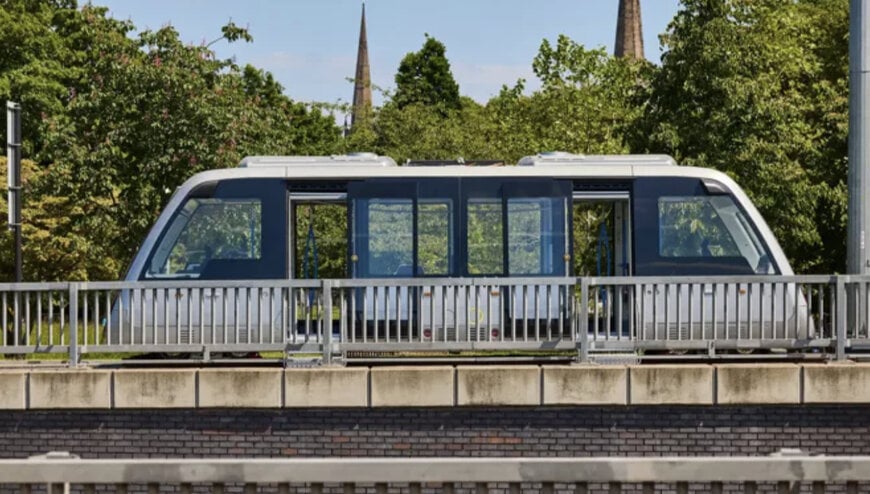
A cooperation between Arup and Tony Gee and Partners is advancing the next phase of the Coventry Very Light Rail (CVLR) programme in Coventry. The partners are responsible for designing an 800-metre twin-track demonstrator route that will test new track construction methods and lightweight vehicle technology for urban rail systems.
Context of the Cooperation
The CVLR programme is led by Coventry City Council and aims to develop a lower-cost alternative to conventional light rail. Traditional tram systems typically require extensive civil engineering works, including deep track foundations and relocation of underground utilities.
The demonstrator project addresses these constraints by testing infrastructure designed to reduce installation time, cost, and disruption in dense urban environments. Cooperation between Arup and Tony Gee was established to combine multidisciplinary expertise in civil engineering, rail systems design, and urban infrastructure integration.
Arup provides programme leadership and systems integration, while Tony Gee contributes engineering design expertise, particularly in structural and infrastructure engineering for transport projects.
Technical Solution and System Design
The CVLR concept integrates a lightweight rail vehicle with a shallow track system intended for installation beneath existing road surfaces. The trackform is designed to be installed approximately 30 cm below the roadway, significantly shallower than conventional light rail trackbeds.
This shallow installation approach reduces the need for relocation of buried utilities such as water, telecommunications, and energy networks. The system therefore aims to simplify construction and reduce disruption during installation.
The vehicles planned for the system are battery-powered and designed to operate without overhead electrification. Eliminating catenary infrastructure reduces installation complexity and visual impact in urban environments. Energy storage systems allow the vehicles to operate across short urban routes while charging strategies can be integrated at designated points along the network.
The collaboration also involves design work across track engineering, civil infrastructure, systems integration, and the interface between rail infrastructure and the surrounding urban environment.
Demonstrator Route Deployment
The demonstrator route will consist of approximately 800 metres of twin track located in Coventry’s city centre and will operate within live traffic conditions. The route is intended to function as a technical test platform for construction methods, operational performance, and integration with existing urban infrastructure.
Data collected during the demonstrator phase will support engineering evaluation of track installation techniques, vehicle operation, and overall system reliability. These findings are expected to contribute to the technical and economic assessment required for a future commercial CVLR route within the city.
The demonstrator project is funded through the City Region Sustainable Transport Settlement (CRSTS) programme and is scheduled for completion by summer 2027.
Applications and Operational Objectives
The CVLR system is intended as a scalable urban mobility solution for medium-sized cities where conventional light rail systems are often considered financially or technically prohibitive. Potential applications include urban transit corridors connecting residential districts, employment zones, and education facilities.
By combining lightweight vehicles, shallow infrastructure, and battery propulsion, the system seeks to reduce construction complexity while maintaining the operational characteristics of rail-based public transport systems, including predictable routing and high passenger capacity.
www.arup.com
