
railway-international.com
25
'26
Written on Modified on
Introduction of an electromechanical brake-by-wire braking system in passenger trains
Trenitalia is integrating Knorr-Bremse's electromechanical braking system to increase energy efficiency and braking performance in Italian passenger transport.
www.knorr-bremse.com
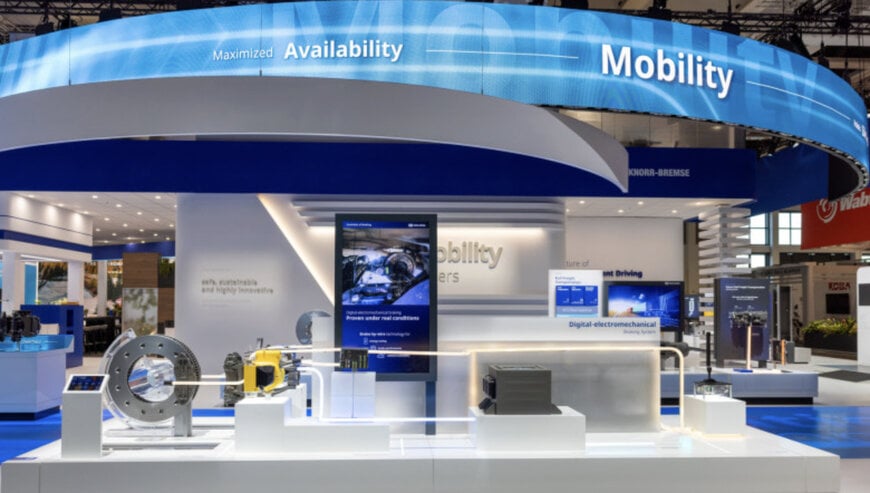
The Italian railway company Trenitalia operates an extensive network for national and regional rail passenger transport. To increase energy efficiency, optimize maintenance processes, and improve braking performance, the operator is equipping its fleet with modern control technologies. As part of this modernization, a novel digital-electromechanical braking system (EM brake) has been implemented in a passenger train in regular operation in Italy.
Technical implementation of brake-by-wire technology
Traditional train braking systems rely on pneumatic and hydraulic components, which are heavy and require regular mechanical maintenance. Knorr-Bremse developed the EM brake as a solution that completely replaces compressed air and hydraulic systems. The technology uses the brake-by-wire principle, in which the braking signal is transmitted electrically and the braking force is generated electromechanically by electric motors. Trenitalia chose this system to overcome the physical limitations of classical compressed air brakes and achieve more dynamic controllability of the electromechanical brake calipers.
System advantages and operational results
The elimination of pneumatic and hydraulic components significantly reduces the total number of components in the braking system. This leads to a marked reduction in train weight, which contributes decisively to lowering energy consumption during operation. Furthermore, high-precision braking force control enables faster reaction times and shorter stopping distances, thereby increasing safety and operational stability. Matthäus Englbrecht, CTO of the Knorr-Bremse Rail Division, explains the technical relevance: « The EM brake is a key technology with enormous potential in terms of performance, energy efficiency, and maintenance optimization. The first deployment in real-world operation will provide further insights with which we will bring the innovation to commercial maturity across various vehicle classes. »
Maintenance and integration into rail transport
Additionally, the system is equipped with telemetry monitoring and diagnostic functions for predictive maintenance. These digital interfaces reduce the effort required by the operator for installation, service, and retrofitting, while optimizing the lifecycle costs of the overall system. At the InnoTrans trade fair, held in Berlin from September 22 to 25, 2026, the technology was presented as a pivotal step toward the compressed-air-free train.
Edited by Maria Brueva, Induportals editor – adapted by AI.
www.knorr-bremse.com
