

railway-international.com
07
'26
Written on
Modified on
ROLLON News
Magnetic Sequential Telescopic Rails for High-Load Motion Control
Rollon introduces redesigned steel assemblies with integrated magnets to synchronize rail extension, minimizing extraction force for heavy industrial and transport applications.
www.rollon.com
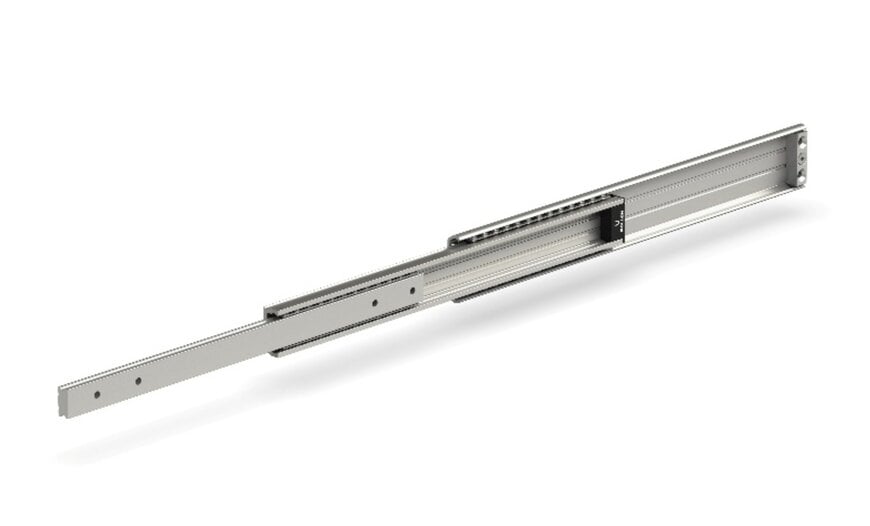
Rollon is releasing the HVC-MG and H1C-MG telescopic rails, which integrate magnetic sequential motion control to optimize load management and extension force. These linear motion solutions are engineered for high-demand environments, specifically targeting heavy industrial machinery and railway sector applications.
Magnetic Motion Control and Redesigned Cage Geometry
The MG version is available for sizes 54 and 68 of the HVC line and size 68 of the H1C line. The primary technical update involves a redesigned ball cage featuring a reduced pitch, which increases the total number of load-bearing balls within the same cage length. This geometric adjustment yields a higher load capacity without altering the external physical dimensions of the rail system. Additionally, the end blocks incorporate internal magnets that dictate a defined motion sequence of the rail elements during extension. This magnetic sequencing results in controlled movement and actively reduces the mechanical force required to open the rail. By optimizing load distribution across a higher volume of balls, the system reduces localized mechanical stress on the raceways, contributing to consistent performance and extended service life.
Material Specifications and Environmental Resistance
The HVC models function as full-extending solutions, while the H1C models are over-extending designs, both configured to maximize physical accessibility in constrained structural spaces. The rails and sliders are manufactured from steel with zinc electroplating, maintaining strict compliance with REACH and RoHS environmental directives. For applications requiring superior corrosion protection, the HVC slides are available in stainless steel configurations. Additional surface treatments can be applied to both ranges to withstand harsh environmental factors.
Railway Sector Applications and Operational Use Cases
Engineered for high rigidity and minimal deflection, the HVC-MG and H1C-MG systems are utilized heavily in construction, automated manufacturing, and railway infrastructure. In railway transport, components must endure continuous exposure to mechanical shocks, sustained vibrations, humidity, and atmospheric contaminants while providing reliable support. Typical technical use cases involve the extraction mechanisms for heavy battery compartments and undercarriage onboard equipment. In these scenarios, the integration of magnets mitigates physical strain on maintenance personnel by ensuring predictable extension dynamics. Andrea Tosi, VP Technology at Rollon, notes that adapting this technology from the existing HGT range provides an ideal combination of load capacity and controlled motion, directly addressing the operational challenges of moving heavy mechanical loads with reduced operating forces.
Public Exhibition Details
The HVC-MG and H1C-MG systems will be publicly exhibited at the Timken Group’s booth 560 in Hall 21 during InnoTrans, a transport technology trade fair taking place September 22–25 in Berlin, Germany.
Additional Context
This section details technical specifications and competitive benchmarking not included in the original news release.
While competing heavy-duty telescopic rails from manufacturers such as Accuride or Chambrelan typically utilize spring-loaded mechanical latches or friction-based pullers to sequence multi-stage extensions, these mechanisms inherently generate wear particles and require higher initial breakaway forces. Rollon’s primary differentiating factor is the integration of contactless magnets within the end blocks to synchronize the intermediate elements. This frictionless magnetic sequencing eliminates the physical degradation associated with metal-on-metal latching. Consequently, the magnetic approach lowers peak contact stress on the raceways during the initial pull phase, yielding a considerably lower required operating force and a superior mean time between failures (MTBF) in high-vibration industrial and transit applications.
Edited by Aishwarya Mambet, Induportals Editor, with AI assistance.
www.rollon.com
