
railway-international.com
15
'26
Written on Modified on
UK rail landslide highlights limits of remote slope monitoring systems
RAIB investigation shows why high-frequency, continuous monitoring is critical for detecting rapid landslides.
www.sensonic.com
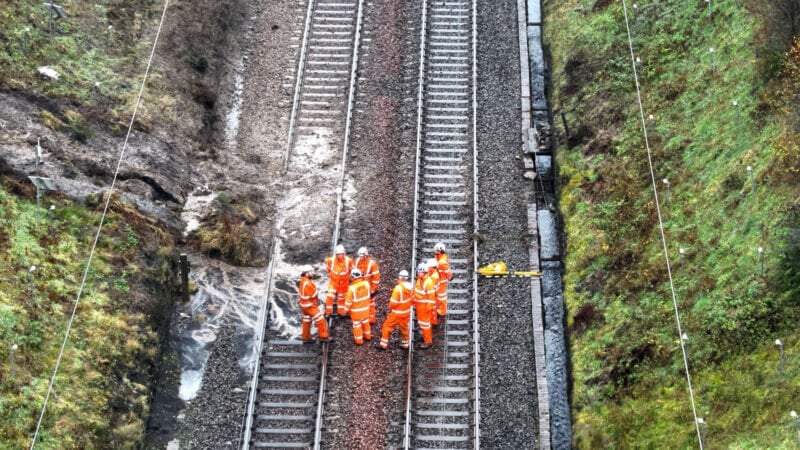
A recent landslide on the UK rail network caused a passenger train to derail at high speed, despite the presence of remote earthworks monitoring equipment at the site. Although the train remained upright and no serious injuries were reported, the incident prompted an independent investigation by the Railway Accident Investigation Branch (RAIB).
The derailment occurred near Shap Summit, between Penrith North Lakes and Oxenholme Lake District stations, when a passenger service operated by Avanti West Coast struck landslip debris that had been washed onto the track following heavy rainfall. In response, RAIB issued Urgent Safety Advice to the wider railway industry and suppliers of landslide detection equipment.
Earthworks monitoring in place but not operational
RAIB’s preliminary findings showed that the cutting slope above the track had been fitted with remote monitoring sensors designed to detect ground movement. However, although the equipment was recording data, it had not been formally entered into operational use and was therefore not configured to send alerts to the Network Rail control centre.
The landslip was triggered when prolonged rainfall overwhelmed a drainage channel above the cutting, saturating the slope and causing material to fail. Sensors installed along the base of the slope recorded small movements several hours before the incident, but these remained below the alert thresholds configured in the system.
When the landslip occurred, the sensors closest to the failure were rapidly displaced and buried by debris. RAIB concluded that the speed of the event prevented the sensors from determining and transmitting their movement before being disabled. Wireless communication was also interrupted once the sensors were covered, preventing alerts from being sent.
Limitations of low-frequency, discrete sensing approaches
The investigation highlighted several limitations associated with discrete, low-frequency sensing systems commonly used for remote earthworks monitoring. These systems typically rely on periodic measurements and wireless data transmission, balancing update rates against battery life.
In this case, sensor movement was recorded at intervals of seconds or longer, meaning rapidly evolving ground failures could occur between measurements. Once buried, the sensors were unable to transmit data until the site was cleared, leaving the monitoring system effectively blind during and immediately after the landslip.
RAIB’s urgent advice reflects concerns that such limitations may reduce the effectiveness of certain monitoring configurations when used to detect fast-moving hazards such as landslides.
Continuous fiber-optic sensing as an alternative approach
In response to the RAIB advice, Sensonic outlined how its fiber-optic–based railway monitoring systems address several of the issues identified in the investigation. Sensonic confirmed that its equipment was not installed at the Shap site and that its landslide detection approach uses a different sensing methodology.
Instead of discrete sensors, fiber-optic cables are installed continuously along the base of a slope, typically below ground level. This creates a continuous sensing element rather than isolated measurement points. Ground movement is detected through vibrations generated during slope instability events, measured at high sampling rates of around 2000 Hz.
Because sensing is continuous and does not rely on wireless transmission from individual sensors, the system remains operational during rapid events and is not affected by debris covering the sensing element, provided the fiber remains intact. If a fiber is damaged, the system generates an immediate alarm and identifies the location of the break.
Implications for future rail safety strategies
The Shap derailment has drawn attention to the need for monitoring technologies that can reliably detect fast-developing geotechnical failures. RAIB’s urgent safety advice underlines the importance of ensuring that installed monitoring systems are fully operational, correctly configured and suited to the hazards they are intended to mitigate.
As rail operators continue to expand the use of remote condition monitoring, the incident highlights the need to match sensing technologies to the dynamic nature of risks such as landslides. Continuous, high-frequency monitoring approaches provide an alternative for applications where rapid ground movement must be detected and communicated in real time to protect railway operations and passenger safety.
www.sensonic.com
